

The change control process is a formalised, step-by-step system that governs how project modifications are requested, evaluated, authorised, implemented, and documented to protect project baselines. As a project manager, you already know that uncontrolled changes are one of the fastest routes to scope creep, budget overruns, and missed deadlines. The change control process, sometimes called integrated change control in PMBOK terminology, sits at the heart of sound project governance. It works alongside change management but serves a distinct function. Where change management focuses on people and adoption, change control focuses on technical evaluation, documentation, and authorisation. Tools like Oracle Primavera Unifier and frameworks like ITIL 4 each provide structured models for applying this process across industries.
What is the change control process and how does it work?
The change control process is defined as a governance mechanism that regulates all modifications to a project's agreed baselines, covering scope, schedule, cost, and quality. PMBOK notes 14 processes generate change requests across a project lifecycle, which means integrated control is not an occasional activity. It is a continuous discipline. Without it, each informal adjustment compounds into plan drift that becomes nearly impossible to reverse.
The process treats every change request as a governance event rather than an administrative task. A change request, often called an RFC (Request for Change) in ITIL environments, triggers a structured sequence of evaluation, risk assessment, approval, and implementation. The outcome is a documented audit trail that protects both the project and the organisation. This traceability is what separates professional project delivery from reactive firefighting.
What are the main steps in the change control process?
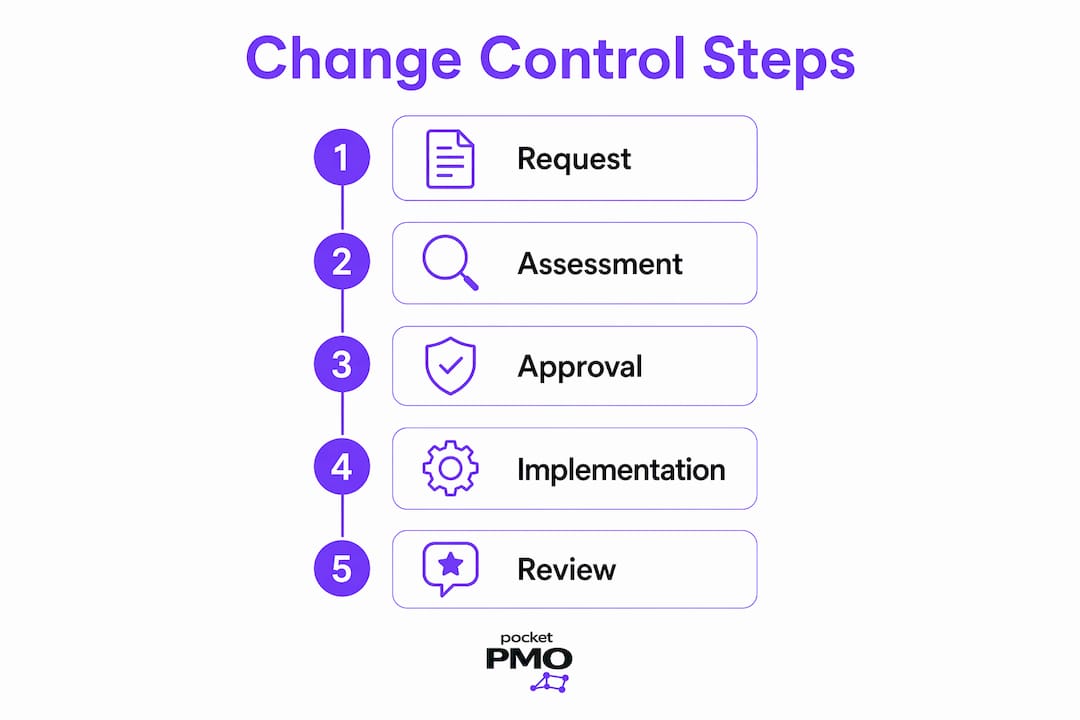
An ITIL-aligned change control process follows a clear sequential workflow from RFC creation through to closure. The stages below reflect best practice across IT, construction, and regulated industries, though the terminology varies by sector.
- Initiate the change request. The requestor submits a formal RFC or change request form capturing the reason, scope of impact, and urgency.
- Evaluate and analyse. The project manager or a designated analyst assesses the change against the triple constraints: scope, schedule, and cost. Risk and resource implications are documented at this stage.
- Categorise and prioritise. Changes are classified by type (standard, normal, or emergency) and ranked by urgency and impact. This determines the approval route.
- Review and approve. The Change Control Board (CCB) or Change Advisory Board (CAB) reviews the submission and either approves, defers, or rejects it. Their decision is formally recorded.
- Implement. Approved changes are executed according to the agreed plan. In construction and vendor contracting, Oracle Primavera Unifier routes change requests automatically for approval before any change order is raised.
- Post-implementation review. The team validates that the change achieved its intended outcome and that no unintended consequences have emerged.
- Close the change. The RFC is formally closed, all documentation is updated, and lessons learned are recorded.
Pro Tip: Before any change moves to implementation, confirm that a backout or rollback plan exists. If post-implementation validation fails, a clear recovery path prevents a controlled change from becoming an uncontrolled incident.
How does change control differ from change management?
Prosci defines change control as governing technical evaluation, authorisation, documentation, and implementation, while change management focuses on preparing and supporting the people affected by the change. The two processes are complementary but serve entirely different functions. Conflating them is one of the most common mistakes project managers make, and it consistently undermines delivery outcomes.
Consider a software migration project. The change control process determines whether the migration is technically approved, scheduled correctly, and documented against the project baseline. Change management determines whether the end users understand the new system, receive adequate training, and actually adopt it. Both are required for success. Neither substitutes for the other.
| Dimension | Change control | Change management |
|---|---|---|
| Primary focus | Technical evaluation and authorisation | People adoption and support |
| Key output | Approved, documented change record | Adoption plan, training, communications |
| Governance body | CCB or CAB | Sponsor, HR, communications lead |
| Failure risk | Unapproved or undocumented changes | Resistance, low adoption, benefit loss |
| Frameworks | ITIL 4, PMBOK, ISO 9001 | Prosci ADKAR, Kotter's 8-Step Model |
Pro Tip: Assign explicit ownership for both processes at project kick-off. If one person owns change control and a separate lead owns change management, the handoff points become clear and neither discipline gets neglected under delivery pressure.
What roles and governance mechanisms support effective change control?
The Change Control Board is the formal decision-making body that reviews, approves, defers, or rejects changes and records those decisions as part of the project record. Not every project requires a full CCB. Smaller projects may delegate approval authority to the project manager or a single sponsor. Larger, regulated, or multi-vendor programmes typically require a standing board with cross-functional representation.

In ITIL environments, the equivalent body is the Change Advisory Board (CAB), which convenes regularly to assess normal changes. For urgent situations, an Emergency Change Advisory Board (ECAB) can be convened rapidly with a smaller quorum to authorise emergency changes. The distinction matters because explicit escalation protocols for major or emergency changes directly improve coordination and reduce risk during crisis events. The Cloudflare data centre outage is a well-documented example of what happens when escalation and control protocols are absent or unclear.
Typical CCB or CAB participant responsibilities include:
- Project manager: Coordinates the change request process, prepares impact assessments, and presents changes to the board.
- Technical lead or architect: Evaluates feasibility, implementation risk, and resource requirements.
- Business analyst or product owner: Assesses alignment with business requirements and user impact.
- Finance representative: Reviews cost implications and budget authority.
- Quality or compliance officer: Confirms regulatory and audit trail requirements are met.
- Sponsor or senior stakeholder: Provides final authority on high-impact or high-cost changes.
The absence of a governance board does not eliminate the need for governance. It simply means decisions are made informally, without documentation, and without accountability. That is where projects lose control of their baselines.
Why is risk and impact assessment crucial in the change control process?
Risk and impact assessment is the analytical core of the change control process. Every proposed change must be evaluated against the triple constraints of scope, schedule, and cost, as well as secondary constraints including quality, resources, and regulatory compliance. Skipping or abbreviating this step is the single most common cause of approved changes that later destabilise a project.
ISO 9001:2015 clause 6.3 requires that planned changes consider purpose, consequences, resources, and responsibilities before implementation. This is not bureaucracy for its own sake. It is a structured prompt to think through second-order effects before committing. In pharmaceutical, aerospace, and financial services projects, this level of rigour is a regulatory requirement. In other sectors, it is simply good practice.
Common techniques used during impact assessment include risk registers, Failure Mode and Effects Analysis (FMEA), and structured impact analysis matrices. Each technique forces the evaluator to consider what could go wrong, how likely it is, and what the consequence would be. The output feeds directly into the approval decision and the contingency plan. A well-maintained change control system also ensures traceability of changes to document revisions and approvals, which is critical during ISO and FDA audits.
Pro Tip: Integrate your risk register directly into your change request workflow. When a new change is submitted, the evaluator should reference open risks to check whether the change introduces, resolves, or escalates any existing risk items. Pocketpmo's AI-driven risk analysis does this automatically, flagging conflicts before they reach the board. You can read more about structured evaluation in this guide to project risk analysis.
How can project managers implement and improve change control in practice?
Effective change control does not require a complex system. It requires consistency, clear documentation, and a process that people actually follow. The most common failure mode is not a missing tool. It is a process that exists on paper but collapses under delivery pressure because it adds friction without visible benefit.
Start with a standardised change request template that captures the requestor, date, description, justification, impact assessment, and approval status. This single document becomes the audit trail. Without it, decisions are made verbally and forgotten. With it, you have a traceable record that protects the project and the team.
Practical tips for mastering change control across your projects:
- Document every change request, regardless of size. Small, undocumented changes accumulate into significant baseline drift.
- Set clear thresholds for what requires board approval versus project manager approval. This prevents bottlenecks without sacrificing governance.
- Communicate approved changes to all affected stakeholders before implementation begins, not after.
- Schedule regular change log reviews during project status meetings to keep the team aligned on what has changed and why.
- Conduct post-implementation reviews within two weeks of each approved change to confirm the outcome matched the intent.
- Use software tools such as ITIL-based service management platforms or Oracle Primavera Unifier to automate routing, notifications, and approval tracking in complex environments.
Pro Tip: Tailor the rigour of your change control process to the project. A two-week internal sprint does not need the same governance overhead as a multi-year infrastructure programme. The process should scale with complexity, not remain fixed regardless of context.
Explore change management examples to see how structured change control translates into measurable project success across different industries.
Key takeaways
Effective change control requires consistent documentation, clear governance, and a structured approval process applied at every stage of the project lifecycle.
| Point | Details |
|---|---|
| Define the process clearly | Change control governs all modifications to scope, schedule, cost, and quality baselines. |
| Follow a structured workflow | The seven-step process from RFC to closure prevents uncontrolled changes and plan drift. |
| Separate control from management | Change control handles technical approval; change management handles people and adoption. |
| Governance bodies are non-negotiable | CCBs and CABs provide accountability, documentation, and informed decision-making authority. |
| Risk assessment drives approval | Every change must be evaluated against the triple constraints before any approval is granted. |
Why change control is harder than it looks in practice
Change control looks straightforward on a process diagram. In practice, it is one of the most politically charged activities in project delivery. The requestor always believes their change is urgent and low-risk. The board always has competing priorities. The project manager sits in the middle, trying to maintain rigour without becoming the person who blocks progress.
The most important lesson I have learned is that governance without trust does not work. If your stakeholders see the change control process as a barrier rather than a protection, they will route around it. They will make verbal agreements, implement changes informally, and only raise the paperwork after the fact. By then, the baseline is already compromised.
The solution is not to simplify the process to the point of meaninglessness. It is to make the value of the process visible. When a change request catches a budget impact that nobody had spotted, or when a post-implementation review prevents a repeat mistake, document that outcome and share it. People follow processes they trust. They circumvent processes they see as bureaucratic overhead.
The distinction between change control and change management is also frequently lost in practice. I have seen projects where the technical change was approved and implemented perfectly, but the affected teams were never properly prepared. The result was a technically successful change that failed in adoption. Both disciplines need a named owner and a clear handoff point.
In 2026, AI-powered platforms are beginning to close the gap between process rigour and practical speed. Automated impact flagging, real-time approval routing, and predictive risk scoring reduce the administrative burden without reducing governance quality. That is the direction the profession is heading.
— Danny
How Pocketpmo supports your change control process
Pocketpmo is an AI-powered PMO platform that brings structured change control into your project workflows from day one. The platform includes built-in change request workflows, approval routing, impact analysis, and a real-time audit trail, so you never lose visibility over what has changed, why, and who approved it. Whether you are managing a single project or a complex portfolio, Pocketpmo gives you the governance infrastructure of a full PMO without the overhead of building one. If you are ready to formalise and automate your change control process, explore what Pocketpmo can do for your team.
FAQ
What is the change control process in project management?
The change control process is a structured system for requesting, evaluating, approving, implementing, and documenting modifications to a project's agreed baselines. It protects scope, schedule, cost, and quality from uncontrolled changes.
What is the difference between a change request and a change order?
A change request is a formal submission proposing a modification, while a change order is the authorised instruction to proceed. In construction and vendor contracting, a change request only becomes a change order after formal approval.
Who sits on a Change Control Board?
A CCB typically includes the project manager, technical lead, business analyst, finance representative, and a senior sponsor. The exact composition depends on project size, industry, and the nature of the change being reviewed.
Why is documentation so important in change control?
ISO 9001:2015 and FDA regulations require traceable change records with clear authorisation histories. Even outside regulated industries, documented changes prevent plan drift and protect the team during audits or disputes.
How does change control relate to risk management?
Every change request should be evaluated against the project risk register. A proposed change may introduce new risks, resolve existing ones, or escalate the likelihood of known issues. Linking the two processes produces better approval decisions and stronger contingency plans.