

AI in risk management is defined as the application of machine learning, predictive analytics, and intelligent automation to identify, assess, and mitigate organisational risks with greater speed and accuracy than traditional manual methods. The 2026 KPMG survey of 400 executives found that AI and generative AI ranked as the most prioritised technology for managing additional risk responsibilities over the next 3–5 years. That finding signals a fundamental shift: risk functions are moving from calendar-driven, subjective assessments to continuous, data-driven programmes. For risk professionals and organisational leaders, understanding the role of AI in risk management is no longer optional. It is the baseline for competitive resilience.
How does AI improve risk assessment and detection?
AI transforms risk assessment by replacing periodic sampling with full-population, real-time analysis. Traditional approaches review a subset of transactions or controls on a fixed schedule. AI monitors every data point, continuously, which means anomalies surface in hours rather than weeks.
The specific capabilities that drive this improvement include:
- Scenario simulation. AI simulates thousands of risk scenarios to identify tail risks and cascading impacts that linear models miss entirely.
- Advanced forecasting. Machine learning models such as quantile regression forests handle non-linear data patterns and process more economic indicators than traditional models. The European Central Bank adopted this approach in Q2 2026 to improve macroeconomic forecasting accuracy.
- Automated risk population. AI auto-populates risk assessments and monitors key risk indicators in real time, removing the manual effort of data gathering from risk teams.
- Key risk indicator tracking. Continuous monitoring flags threshold breaches the moment they occur, not at the next scheduled review.
The shift from subjective manual assessment to quantitative, data-driven programmes is the defining change in modern risk analysis. Organisations that still rely on quarterly risk reviews are working with a photograph of risk. AI gives you a live feed.
Pro Tip: When deploying AI for risk detection, start with a single high-volume control, such as payment approvals or access rights reviews. Prove accuracy there before expanding to broader risk categories. Early wins build internal confidence and reduce resistance from audit committees.

What is AI's impact on risk mitigation and operational efficiency?
AI does not just detect risk. It actively supports the response. The practical impact on risk mitigation falls into three areas: control testing, anomaly detection, and risk reporting.
- Automated control testing. AI automates control testing activities, validates control effectiveness, and detects anomalies across large data sets. This reduces manual effort significantly and accelerates the identification of control weaknesses before they become incidents.
- Recommended response strategies. AI analyses historical outcomes and recommends risk ratings and response strategies, giving risk managers a starting point rather than a blank page.
- Thematic risk reporting. Natural language processing tools scan internal documents, incident reports, and external news to surface thematic risks. This replaces hours of manual reading with structured, prioritised outputs.
The continuous learning aspect is what separates AI from static rule-based tools. Each cycle of control testing feeds back into the model, improving accuracy and coverage over time. For AI risk mitigation to work at scale, you need clean historical data and clearly defined control objectives. Without those inputs, the model learns the wrong patterns.
Pro Tip: Build a feedback loop into your AI risk mitigation process. When a recommended response is overridden by a human expert, capture the reason. That data trains the model to make better recommendations in future cycles.
For a broader view of how AI reshapes delivery and oversight functions, the AI-powered PMO guide covers the governance structures that support this kind of continuous monitoring.
What are the limitations and governance considerations of AI in risk?
AI is not a universal solution for risk management. Understanding where it excels and where it fails is the difference between a well-governed programme and a regulatory liability.
- Core aggregation requires deterministic software. AI excels at data preparation and risk communication, but core risk aggregation and capital allocation must remain in hard-coded, auditable software. Regulators require a clear, reproducible calculation trail. Generative AI cannot provide that.
- Overreliance on generative AI is a documented pitfall. Using large language models to produce quantitative risk aggregations introduces opacity. When an auditor asks how a capital figure was derived, "the AI calculated it" is not an acceptable answer.
- Model bias and explainability must be governed. Developing an AI Risk Management Framework that covers model bias, explainability, and data lineage is a prerequisite for deployment, not an afterthought. Deloitte practitioners note that early governance investment reduces costly retroactive compliance work.
- Data lineage is a regulatory requirement. Regulators in the UK and EU increasingly expect firms to document where AI inputs originate, how they are processed, and how outputs influence decisions. Firms without data lineage controls face growing scrutiny.
- Regulatory frameworks are still maturing. The absence of a single global AI governance standard means organisations must monitor multiple jurisdictions simultaneously. Consulting firms that specialise in AI security frameworks are increasingly engaged to fill this gap.
The governance point is not a reason to delay AI adoption. It is a reason to build the framework before scaling the technology.
How can organisations integrate AI into risk frameworks effectively?
Practical integration of AI into risk management requires more than buying a platform. It requires re-engineering how risk data is structured, governed, and consumed.
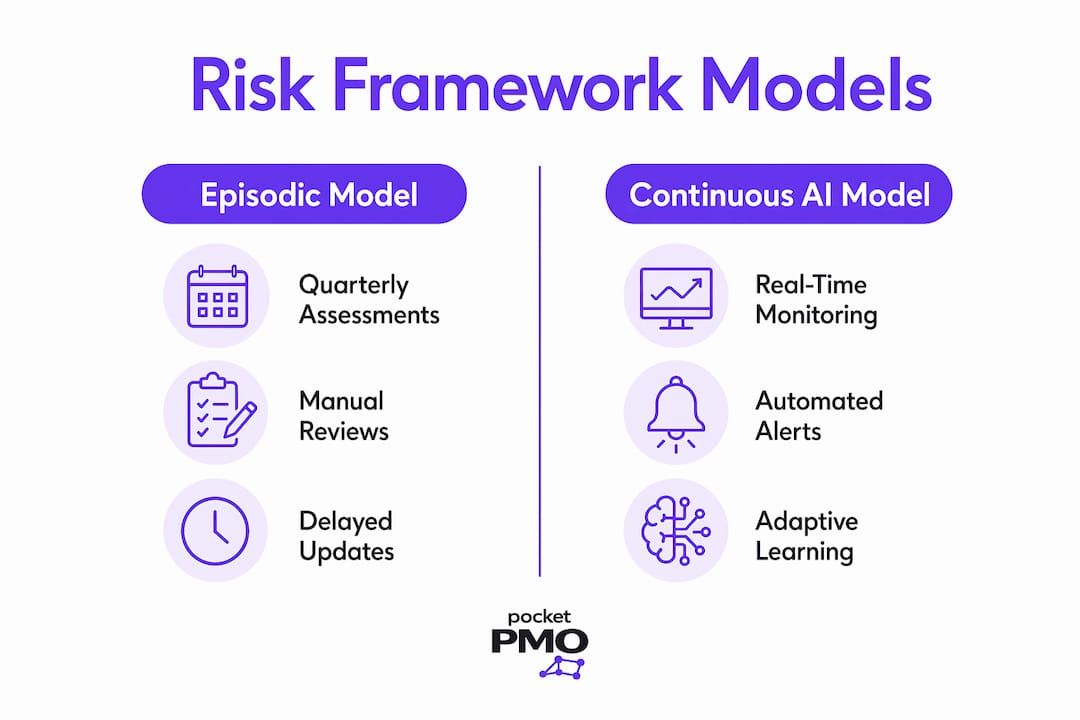
The table below contrasts the episodic model most organisations currently operate with the continuous, AI-native model that leading companies are moving towards.
| Dimension | Episodic model | Continuous AI model |
|---|---|---|
| Assessment frequency | Quarterly or annual | Real-time, ongoing |
| Data scope | Sample-based | Full population |
| Control testing | Manual, periodic | Automated, continuous |
| Risk reporting | Narrative, retrospective | Quantitative, forward-looking |
| Human role | Primary analyst | Oversight and decision-maker |
The most common reason early AI risk projects stall is inconsistent internal data. Machine-readable taxonomies are a prerequisite. If your risk categories, control labels, and incident classifications differ across business units, the AI model cannot aggregate meaningfully. Standardising that language before deployment is the single highest-value preparatory step.
Early investment in model governance also lowers future audit costs. Firms that embed AI governance frameworks within enterprise risk processes from the outset gain a measurable advantage when regulators arrive. Those that retrofit governance after deployment spend significantly more time and resource on remediation.
The human element remains critical. AI provides the quantitative muscle. Risk professionals provide the contextual judgement. The most effective integration models position AI as a first-line continuous control monitor, with human experts reviewing outputs, challenging assumptions, and making final decisions on material risks. For a practical framework on embedding AI into project risk analysis, the methods and pitfalls guide covers the common failure points in detail.
Cultural adoption matters as much as technical deployment. Risk teams that understand how the AI model works, what its limitations are, and how to interpret its outputs will use it effectively. Teams that treat it as a black box will either over-trust it or ignore it entirely.
Key takeaways
AI in risk management delivers the most value when it combines continuous monitoring, machine-readable data, and human oversight within a governed framework.
| Point | Details |
|---|---|
| AI shifts risk assessment to real-time | Full-population monitoring replaces periodic sampling, surfacing risks faster. |
| Governance must precede scale | Build an AI Risk Management Framework covering bias, explainability, and data lineage before expanding deployment. |
| Core aggregation stays deterministic | Use hard-coded, auditable software for capital allocation; AI handles preparation and communication. |
| Machine-readable data is the foundation | Standardise risk taxonomies across business units before integrating AI agents. |
| Human oversight remains non-negotiable | AI recommends; risk professionals decide. The combination outperforms either alone. |
Why I think most organisations are integrating AI in the wrong order
Most risk functions I have worked with approach AI adoption the same way: they buy the technology, then discover their data is not ready for it. The taxonomy is inconsistent. Incident classifications vary by region. Control labels mean different things in different business units. The AI model then learns from that inconsistency and produces outputs that no one trusts.
The organisations that get this right do the unglamorous work first. They standardise their risk language. They audit their data lineage. They define what "good" looks like for each control before asking an algorithm to assess it. That preparation takes months, but it is what separates a functioning AI risk programme from an expensive proof of concept that never scales.
The governance conversation also tends to arrive too late. I have seen firms deploy generative AI for risk summarisation and then face regulator questions about explainability that they cannot answer. The AI governance guide for executives is worth reading before you reach that point, not after.
My honest view is that AI's role in risk management is not to replace risk professionals. It is to give them the quantitative capacity that was previously only available to financial risk disciplines. Used well, it makes every risk manager more effective. Used without governance, it creates a new category of risk.
— Danny
How Pocketpmo supports AI-powered risk management
Risk professionals need more than AI capability. They need a platform that puts that capability to work from day one, without building a PMO from scratch.
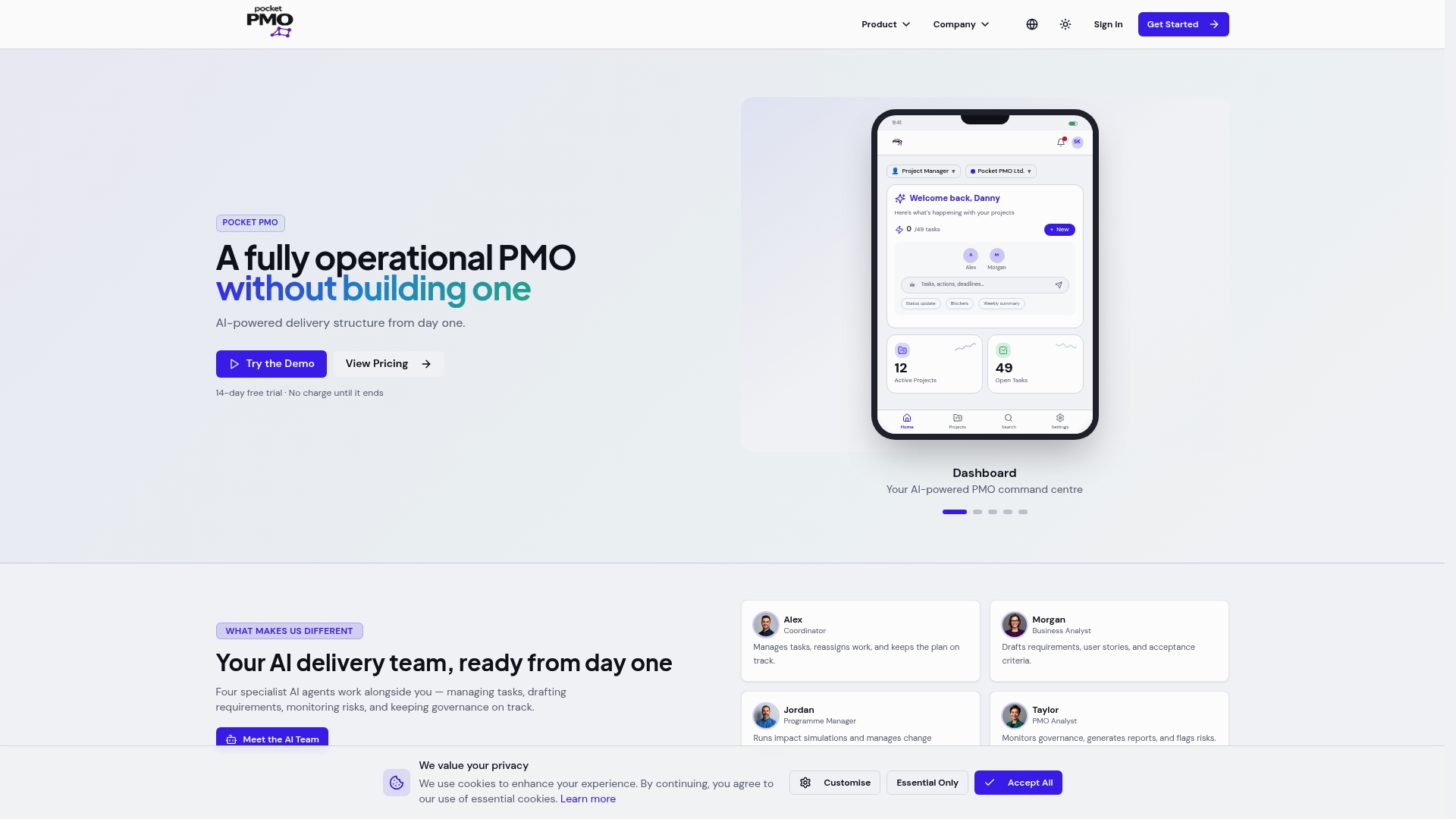
Pocketpmo delivers an AI-powered PMO that integrates real-time risk monitoring, automated RAID management, and predictive analytics across your entire project portfolio. The platform auto-generates risk assessments, tracks key risk indicators continuously, and surfaces issues before they escalate. You get the governance structure, the reporting, and the AI-driven insight without the overhead of building it internally. See the platform in action with the snapshot demo and assess whether it fits your risk management workflow.
FAQ
What is the role of AI in risk management?
AI in risk management automates risk identification, assessment, and control monitoring using machine learning and predictive analytics. It enables continuous, full-population analysis rather than periodic manual reviews.
How can AI help in risk mitigation?
AI recommends risk response strategies based on historical outcomes, automates control testing, and detects anomalies in real time. This reduces manual effort and accelerates the identification of control weaknesses.
What are the limitations of AI in risk assessment?
AI excels at data preparation and risk communication but cannot replace deterministic software for core risk aggregation and capital allocation, which require full auditability for regulatory compliance.
What governance does an AI risk programme require?
An AI Risk Management Framework covering model bias, explainability, and data lineage is required before deployment. Early governance investment reduces retroactive compliance costs and satisfies regulatory scrutiny.
How does machine learning improve risk forecasting?
Machine learning models such as quantile regression forests handle non-linear data patterns and process more economic indicators than traditional linear models, improving forecasting accuracy across complex risk environments.