

AI in predictive planning is defined as the application of machine learning and intelligent automation to continuously update forecasts, model multiple future scenarios, and recommend optimal decisions based on live data. Where traditional planning relied on static quarterly assumptions and manual spreadsheets, the role of AI in predictive planning is to replace that rigidity with adaptive, data-driven intelligence. Organisations using AI in Enterprise Performance Management (EPM) platforms, generative AI tools, and Agentic AI models are already seeing measurable gains in forecast accuracy, planning speed, and strategic confidence. The shift is not incremental. It is a fundamental change in how planning teams operate.
How does AI improve forecasting accuracy and reduce planning errors?
Applying AI to forecasting can reduce forecast error by 20%–50%, depending on data quality and model design. That range matters because it tells you the ceiling is high, but only if your data inputs are clean and your model is fit for purpose.
Traditional forecasting models rely on fixed assumptions. A financial planner sets growth rates at the start of the year and revisits them quarterly. AI replaces that cycle with continuous learning. Machine learning models ingest new data from sales pipelines, market signals, and operational systems in real time, then update predictions automatically. The result is a forecast that reflects what is actually happening, not what was assumed six months ago.
AI demand forecasting is a strong example. Retailers and manufacturers using AI-driven demand models have moved from monthly batch forecasting to daily or even hourly updates. Financial planning teams using AI within EPM platforms such as Anaplan or Oracle EPM report similar gains, with models that adjust revenue projections as new bookings land rather than waiting for period-end reviews.

Pro Tip: Data quality determines forecast quality. Before deploying any AI forecasting model, audit your data sources for completeness, consistency, and latency. A well-designed model fed poor data will still produce poor forecasts.
The mechanism behind the accuracy gain is straightforward. AI models identify non-linear patterns across large, diverse datasets that human analysts and traditional statistical models miss. They incorporate market data, operational metrics, and external signals simultaneously. That breadth of input is what drives the error reduction.
What role does AI play in scenario planning and exploring multiple futures?
Scenario planning and forecasting are not the same thing. Forecasting produces a single most-likely outcome. Scenario planning maps a range of plausible futures so that decision-makers can prepare for each one. AI is particularly powerful here because scenario modelling time compresses from weeks to hours, allowing teams to test dozens or hundreds of variable combinations rapidly.
Consider a strategic planning team assessing the impact of a 15% increase in raw material costs alongside a 10% drop in consumer demand. Manually building and stress-testing that scenario in a spreadsheet model takes days. An AI-assisted planning system runs it in minutes, then runs fifty variations alongside it.
The table below shows the practical difference between traditional and AI-assisted scenario planning:
| Capability | Traditional planning | AI-assisted planning |
|---|---|---|
| Scenarios tested per cycle | 3–5 | Dozens to hundreds |
| Time to model a new scenario | Days to weeks | Hours or less |
| Data sources integrated | Manual, siloed | Automated, multi-source |
| Update frequency | Quarterly | Continuous |
| Human effort required | High | Reduced, focused on interpretation |
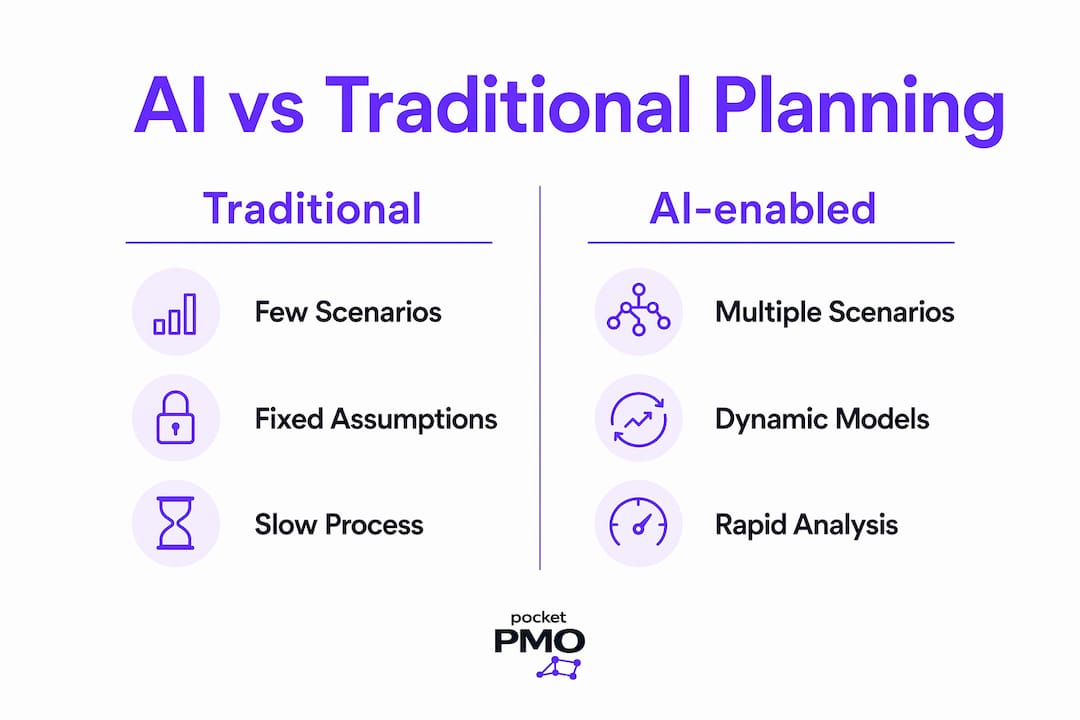
Beyond speed, AI brings counterfactual reasoning to scenario planning. You can ask: "What would have happened to our margin if we had delayed the product launch by three months?" AI models simulate that intervention and return a quantified answer. That capability turns uncertainty into a structured set of choices rather than a fog of unknowns.
Modern planning AI systems not only predict what might happen but evaluate what should happen, balancing objectives like cost, quality, and compliance. This shift from predictive to prescriptive analytics is where the real strategic value lies.
Pro Tip: Use AI scenario planning to build a small library of pre-modelled responses to your highest-probability risks. When a risk materialises, your team already has a validated response plan rather than starting from scratch.
In what ways does AI automate and optimise planning workflows?
AI automation in planning goes well beyond generating forecasts. It covers the full data pipeline from collection through to insight delivery. AI integration into EPM platforms yields significant annual time savings, including 175 hours in risk management and 125 hours in demand forecasting and financial planning. Those are not trivial numbers. They represent weeks of analyst capacity redirected from data wrangling to decision-making.
The key automation benefits break down as follows:
- Data gathering and cleansing: AI agents pull data from ERP systems, CRM platforms, and external market feeds, then normalise and validate it automatically. Manual data preparation, which often consumes 60%–80% of a planner's time, drops sharply.
- Report generation: Generative AI tools produce narrative status reports, variance analyses, and board summaries from structured data. Planners review and approve rather than write from scratch.
- Natural language interfaces: Agentic AI models enable conversational interfaces where business users ask questions in plain English and receive forecast outputs or recommendations directly. No SQL, no pivot tables.
- Workflow orchestration: Agentic AI acts as an orchestrator, triggering downstream tasks when conditions are met. A forecast revision above a set threshold can automatically flag a budget review, notify stakeholders, and update the risk register.
The democratisation of insight is a significant organisational benefit. When a sales director can query the planning model directly through a chat interface, the dependency on specialist analysts for every ad hoc question disappears. Decisions get made faster and with better information.
Pro Tip: Start AI workflow automation with your highest-friction processes, not your most complex ones. Quick wins in data gathering and report generation build team confidence and demonstrate ROI before you tackle more sophisticated modelling tasks.
For a detailed look at how AI-driven workflows translate into project delivery efficiency, the practical examples are worth reviewing.
What are the challenges and limitations of AI in predictive planning?
AI in predictive planning is not without its constraints. Understanding them is what separates teams that get lasting value from those that encounter expensive failures.
The most operationally significant risk is model hallucination. AI models, particularly large language models (LLMs), can generate outputs that are internally coherent but factually wrong or physically impossible. AI models can produce outputs that violate physical or logical constraints, which is why bounding rules and post-processing validation layers are not optional. They are a core part of any reliable AI planning architecture.
A second limitation is the weakness of generative AI in complex business reasoning. Generative AI alone struggles with multi-variable optimisation problems and requires integration with tested solver programmes to avoid generating impossible or erroneous outcomes. An LLM asked to optimise a production schedule across 200 SKUs with capacity constraints will not produce a reliable answer without a mathematical solver underpinning it.
Practical limitations to plan for include:
- Data dependency: AI models are only as reliable as the data they are trained on. Gaps, biases, or stale data in your inputs produce unreliable outputs.
- Interpretability: Complex machine learning models can be difficult to explain to senior stakeholders. If a planner cannot articulate why the model produced a particular forecast, trust erodes quickly.
- Over-reliance risk: Teams that defer entirely to AI outputs without human validation lose the critical thinking skills needed to catch errors.
- Implementation complexity: Integrating AI with legacy ERP and finance systems requires significant technical effort and change management.
The most effective AI planning implementations combine machine learning's pattern recognition with traditional model constraints. Hybrid approaches preserve operational reliability while capturing the accuracy gains that pure AI models deliver.
A phased implementation approach reduces these risks substantially. Begin with a single high-impact workflow, validate outputs rigorously, and expand from there. Teams that attempt full-scale AI transformation in one step consistently encounter more problems than those who build incrementally.
For a broader view of how AI-powered PMO governance manages these risks in practice, the governance frameworks are directly applicable to planning contexts.
Key takeaways
AI in predictive planning delivers its greatest value when machine learning accuracy, scenario speed, workflow automation, and human oversight are combined deliberately rather than deployed in isolation.
| Point | Details |
|---|---|
| Forecast error reduction | AI reduces forecast errors by 20%–50%, but only when data quality and model design are prioritised. |
| Scenario planning speed | AI compresses scenario modelling from weeks to hours, enabling continuous strategic resilience. |
| Workflow time savings | EPM platforms with AI integration save up to 175 hours annually per planning activity through automation. |
| Hybrid models outperform | Combining AI with traditional constraints produces more reliable outputs than either approach alone. |
| Human oversight is non-negotiable | Bounding rules and human validation prevent AI hallucinations from corrupting planning decisions. |
Why I think most teams are adopting AI planning the wrong way
Most planning teams I speak with approach AI adoption in one of two ways. Either they buy an AI-enabled platform and expect transformation to happen automatically, or they run a proof-of-concept on a low-stakes workflow and never scale it. Neither approach works.
The teams that get genuine results start with a specific, painful problem. Not "improve our forecasting" but "our demand forecast for the top 20 SKUs is consistently 30% off, and it costs us £400,000 a year in excess stock." That specificity drives the right model design, the right data investment, and the right success metric.
What I have observed consistently is that AI's biggest impact on planning is not the forecast itself. It is the speed at which teams can respond to new information. When your scenario library is pre-built and your data pipeline is automated, a supply chain disruption at 9am can have a modelled response on the leadership table by 11am. That agility is worth more than any marginal improvement in forecast accuracy.
The uncomfortable truth is that AI does not replace the need for strong planning judgement. It amplifies it. A team with weak analytical discipline will make worse decisions faster with AI. A team with strong discipline will make better decisions faster. The human element is not a limitation to work around. It is the multiplier.
My recommendation: before you invest in any AI planning tool, including platforms like Pocketpmo, map your current planning process in detail. Identify where time is lost, where errors originate, and where decisions are delayed. Then target AI at those specific points. The practical applications of AI in project management follow the same logic. Start specific, prove value, then expand.
— Danny
See how Pocketpmo puts AI-driven planning into practice
If you are evaluating how to bring AI into your planning and delivery processes without building a PMO from scratch, Pocketpmo is worth a close look. The platform combines real-time dashboards, AI-driven risk analysis, and predictive analytics into a single PMO solution that is operational from day one.
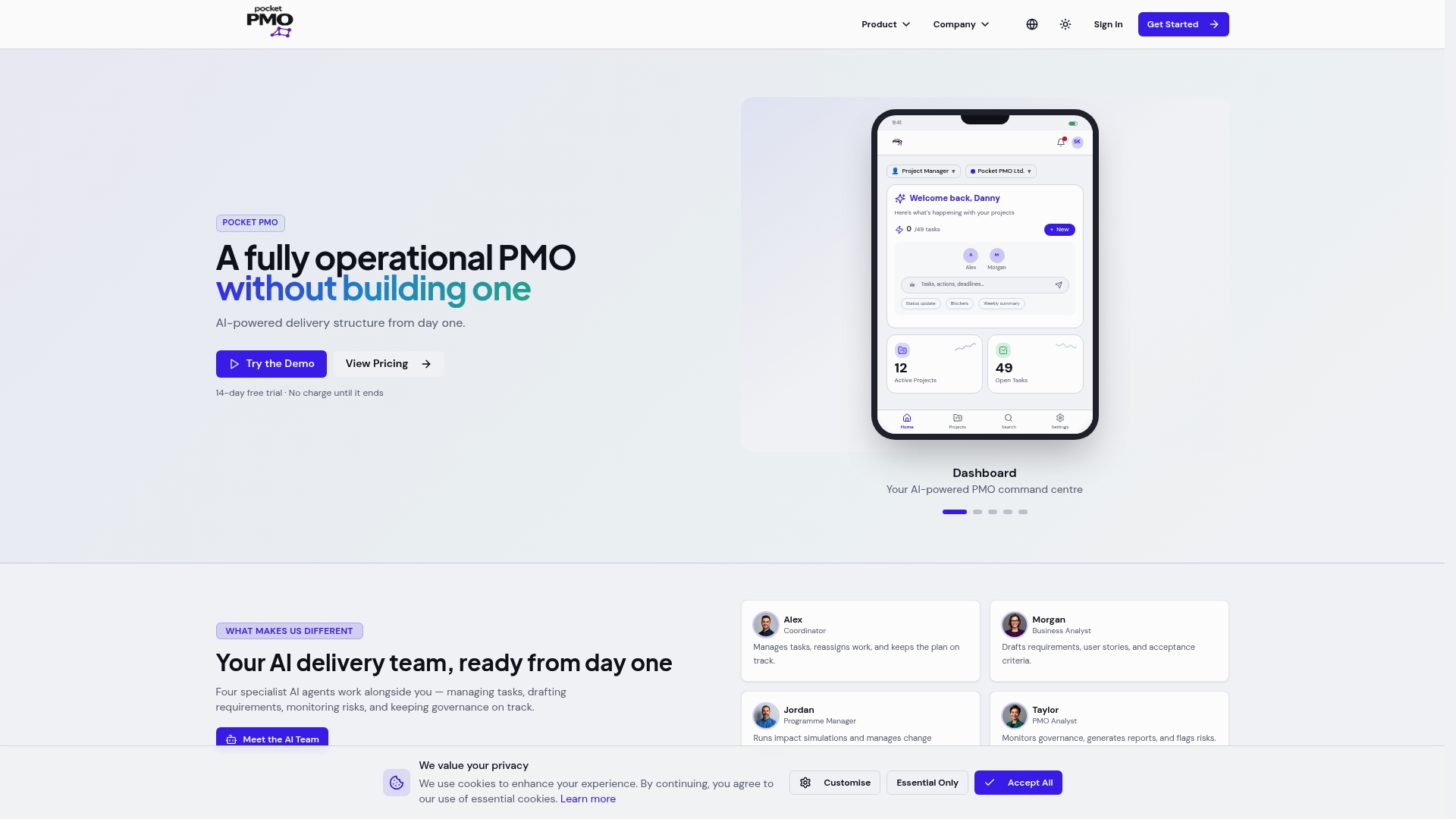
Pocketpmo automates data gathering, status reporting, and risk tracking across your entire project portfolio. You get the benefits of an AI-powered PMO without the overhead of building and staffing one internally. If you are comparing options, the detailed breakdowns against Microsoft Project and Monday.com show exactly where the AI capabilities differ. Take the demo and see the forecasting and scenario tools working on your own project data.
FAQ
What is the role of AI in predictive planning?
AI in predictive planning applies machine learning to continuously update forecasts, model multiple future scenarios, and recommend optimal decisions based on live data. It replaces static quarterly assumptions with adaptive, real-time intelligence.
How much can AI reduce forecast errors?
AI can reduce forecast errors by 20%–50% depending on data quality and model design. The improvement comes from AI's ability to process diverse, real-time data sources that traditional statistical models cannot handle.
What is the difference between predictive and prescriptive AI planning?
Predictive AI forecasts what is likely to happen. Prescriptive AI goes further by evaluating trade-offs and recommending the optimal course of action, balancing objectives such as cost, quality, and compliance simultaneously.
Why do AI planning models need human oversight?
AI models can generate outputs that violate physical or business constraints, particularly when large language models are used without solver integration. Human validation and bounding rules are required to keep forecasts reliable and operationally valid.
How does Agentic AI change planning workflows?
Agentic AI enables conversational, natural-language interfaces where business users query forecasts and receive recommendations directly, without specialist analyst support. It also orchestrates downstream tasks automatically when planning thresholds are triggered.