

An AI delivery team is defined as a group that embeds AI agents directly into every stage of project delivery, redesigning workflows around AI execution rather than simply adding tools to existing processes. This distinction matters enormously. AWS research shows frontier teams with AI-native development achieved up to 4.5x productivity gains, compressing a 90-week project into 24 weeks. The role of AI delivery teams goes far beyond automation. It represents a fundamental shift in how project work is structured, governed, and executed. For project managers and business leaders, understanding this shift is the difference between incremental improvement and a step change in delivery capability.
How do AI delivery teams differ from traditional project teams?
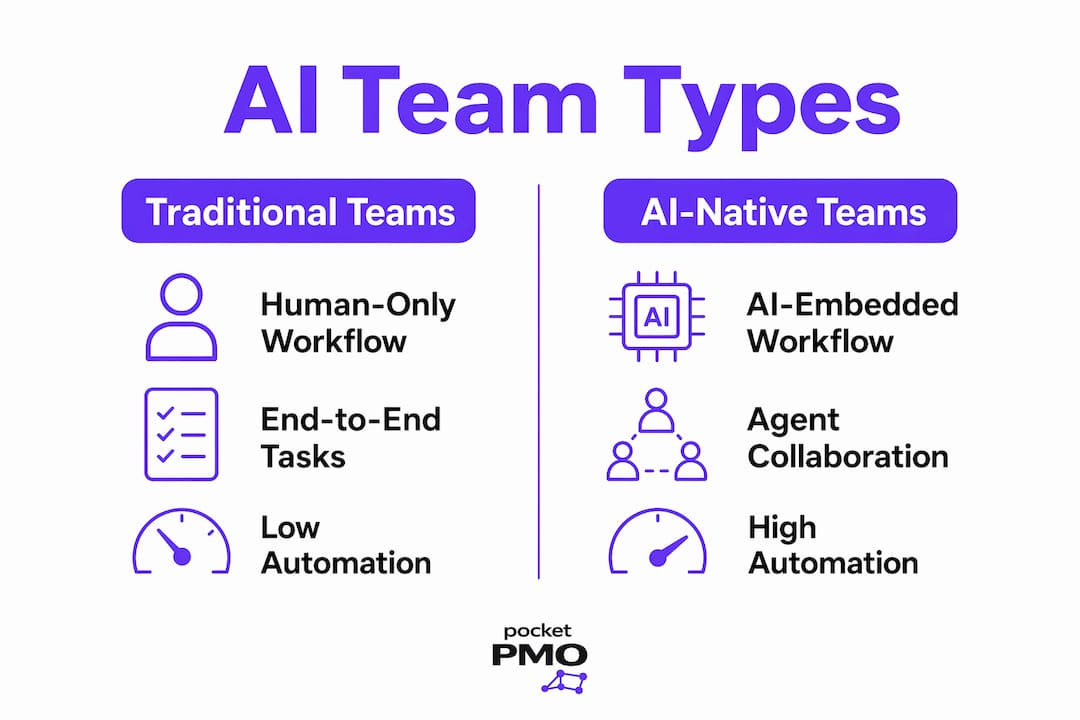
AI delivery teams are not traditional teams with better tools. The distinction is structural. AI-native teams manage 70%–90% of structured work through AI agents, achieving 5x to 10x lifecycle delivery gains. AI-enabled teams, by contrast, add copilots or assistants to existing workflows and gain only 20%–40% on individual tasks. That gap reflects a fundamental difference in design philosophy, not tool quality.
The clearest test is what practitioners call the "swap test." Remove the AI tools from an AI-native team and the operating model collapses entirely. Remove them from an AI-enabled team and the team slows down but continues to function. If the team cannot operate without AI, it is genuinely AI-native. This distinction shapes every hiring, governance, and workflow decision a project leader makes.

Role definitions also change fundamentally. In traditional teams, engineers and analysts own end-to-end tasks. In AI-native teams, humans focus on judgement, validation, and orchestration. AI agents handle structured execution. AI-native delivery is an organisational design challenge, not a tool adoption exercise. Roles must be redefined for probabilistic systems, where outputs require human verification rather than deterministic trust.
| Dimension | Traditional team | AI-enabled team | AI-native team |
|---|---|---|---|
| Workflow design | Human-centred tasks | Human tasks with AI assist | AI execution with human oversight |
| Productivity gain | Baseline | 20%–40% per task | 5x–10x lifecycle gains |
| AI dependency | None | Optional | Structural |
| Role focus | Full task ownership | Task completion with tools | Judgement, governance, orchestration |
| Failure mode | Human error | Tool misuse | Poor handoff protocols |
Pro Tip: Before adopting AI-native practices, run the swap test on your current team. If removing AI tools merely slows you down, you are still operating an AI-enabled model. That is a useful baseline, not a destination.
What does an effective AI delivery pod look like?
The AI delivery pod is the operational unit of AI-native teams. Pods consist of 4–6 humans supported by AI agents, operating at double the throughput of traditional teams of equivalent size. The compact size is deliberate. Smaller human groups reduce coordination overhead while AI agents absorb the volume of structured work that would otherwise require a larger headcount.
Within a pod, each human role maps to a specific delivery stage. A typical pod includes:
- AI orchestrator. Directs agent tasks, reviews outputs, and manages handoff protocols between humans and AI.
- Domain lead. Provides subject matter judgement that agents cannot replicate. Validates agent output against business context.
- Quality assurance engineer. Reviews structured agent output at each stage. Prevents errors from compounding across the delivery cycle.
- Data or integration specialist. Manages data pipelines, agent inputs, and system connections that agents depend on.
- Delivery coordinator. Tracks progress, flags blockers, and maintains the governance record across the pod's work.
- AI agents. Execute structured tasks: drafting, testing, documentation, analysis, and code generation at each stage.
Scaling works by grouping pods rather than enlarging them. Larger programmes add senior AI architect and data scientist roles to coordinate across multiple pods. This preserves the throughput advantage of the compact model while extending capacity. For project managers overseeing AI tools for multi-project management, the pod model provides a clear unit of planning and resource allocation.
Pro Tip: Map your delivery stages before assigning AI agents. Agents perform best when given a defined scope. Assigning an agent to "help with the project" produces far weaker results than assigning it to "draft the weekly status report from the RAID log every Friday."
How do AI delivery teams reshape project management?
The most significant change AI delivery teams bring to project management is the shift from passive tool use to active AI participation. The delivery loop model integrates AI as a participant in meetings, synthesising context in real time and supporting decisions as they are made. This differs fundamentally from querying an AI tool after a meeting. Human conductors steer AI output across pre-meeting preparation, live discussion, and post-meeting follow-up.
Decision speed and accuracy both improve when AI participates in the delivery loop. AI agents synthesise data from multiple sources simultaneously, surfacing risks and dependencies that human reviewers might miss under time pressure. The human conductor role exists to validate and direct that synthesis, not to replicate it manually. This division of labour produces faster, better-informed decisions without removing human accountability.
Governance changes equally. High-performing AI-native teams embed governance and monitoring from project inception rather than applying them at review gates. No single role owns the lifecycle. Observability is continuous. This approach prevents the failure modes common in traditional delivery, where governance is retrospective and concentrated in one function. For project leaders, embedding governance from the start is not optional. It is the mechanism that makes AI-native delivery trustworthy at scale.
| Workflow element | Before AI embedding | After AI embedding |
|---|---|---|
| Meeting preparation | Manual briefing documents | AI-synthesised context packs |
| Risk identification | Periodic human review | Continuous agent monitoring |
| Status reporting | Weekly manual updates | Real-time automated dashboards |
| Governance ownership | Single role or PMO | Distributed across all pod members |
| Decision support | Historical data queries | Live synthesis during discussion |
What practical steps build an AI-native delivery team?
Building an AI-native delivery team requires preparation before a single line of production code is written. Agent context building involves creating detailed steering files, templates, and domain knowledge repositories that agents draw on throughout delivery. Without this preparation, agents lack the context to produce reliable output. Teams that skip this step spend more time correcting agent errors than they save through automation.
The practical steps for project leaders are:
- Run a pilot pod first. Select one project and one pod of 4–6 people. Build agent context for several weeks before assigning agents to production tasks. Measure throughput against your baseline.
- Redesign workflows around AI execution. Map every delivery stage and identify which tasks are structured enough for agent execution. Restructure human roles around the judgement and validation work that remains.
- Define handoff protocols explicitly. Handoff protocols determine whether agent output is trustworthy. Agents produce structured output that humans validate at each stage. Without clear protocols, errors compound and erode confidence in the model.
- Embed quality assurance at every stage. Do not treat QA as a final gate. Assign QA responsibility within the pod at each handoff point. This prevents costly errors from reaching later delivery stages.
- Measure the right metrics. Track commit velocity, deployment frequency, and developer satisfaction alongside traditional project metrics. These indicators reveal whether the AI-native model is genuinely improving throughput or simply shifting effort.
- Maintain firm control of architecture and adoption. AI success depends on firm control of architecture, workflow, and adoption to ensure durability despite tool churn. The specific AI tools will change. The workflow design must not.
For project leaders considering the transition, a free AI strategy consultation can help assess where your current team sits on the AI-native spectrum and which structural changes will deliver the greatest return.
Key takeaways
AI-native delivery teams achieve 5x to 10x lifecycle gains by redesigning workflows around AI execution, not by adding tools to existing processes.
| Point | Details |
|---|---|
| AI-native vs AI-enabled | AI-native teams restructure workflows around agents; AI-enabled teams add tools and gain only 20%–40% per task. |
| Pod model efficiency | Compact pods of 4–6 humans with AI agents operate at double the throughput of equivalent traditional teams. |
| Governance from day one | Embedding monitoring and observability from project inception prevents failure and distributes accountability. |
| Context before code | Building agent context through steering files and templates before production work is critical for reliable AI output. |
| Handoff protocols matter | Clear human-to-agent handoff protocols prevent errors from compounding and determine whether AI output is trustworthy. |
The design problem most teams are ignoring
Most project leaders I speak with treat AI adoption as a procurement decision. They select a tool, roll it out, and measure adoption rates. That framing misses the point entirely. The teams achieving genuine throughput gains are not the ones with the best AI tools. They are the ones that redesigned their operating model first and then selected tools to fit it.
The uncomfortable reality is that AI-native delivery is an organisational design challenge. It requires you to redefine roles, redistribute accountability, and accept that some of your most experienced people will need to learn new ways of working. That is harder than buying software. It is also the only approach that produces the 5x to 10x gains the research consistently shows.
I have also noticed that teams underestimate the importance of human roles in AI-native models. The assumption is that AI reduces the need for experienced project managers and domain leads. The opposite is true. AI agents amplify the quality of human judgement. Poor judgement at the orchestration layer produces poor output at scale. Investing in the human roles that govern and direct AI agents is not a cost. It is the primary success factor.
The future of AI delivery teams will involve more sophisticated agents, tighter integration with governance frameworks, and clearer standards for observability. The teams that build strong human-agent collaboration habits now will adapt to those changes far more easily than those still treating AI as a passive assistant. For a broader view of how this applies to consulting contexts, the role of AI in consultancy guide covers the organisational design questions in detail.
— Danny
How Pocketpmo supports AI-augmented project delivery
Pocketpmo is built for project managers who need AI-native capabilities without building a PMO from scratch.
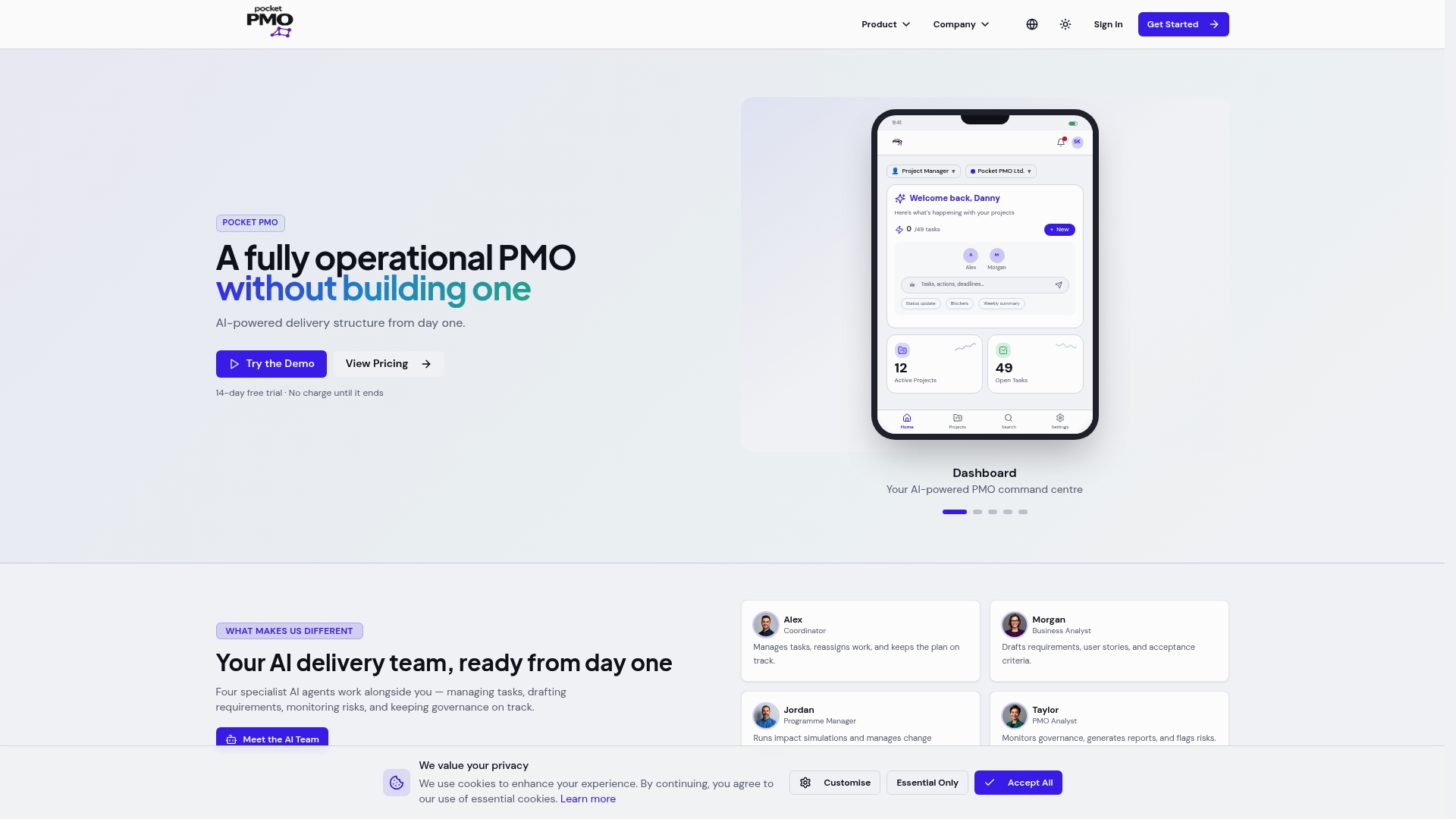
The platform combines real-time dashboards, AI-driven risk analysis, and automated status reporting into a single governance layer that works across multiple projects simultaneously. Pocketpmo's delivery team model deploys AI agents capable of managing tasks, requirements, and risks from day one, reflecting the pod-based approach this article describes. Portfolio management, RAID tracking, and change request workflows are all embedded with continuous monitoring, so governance is never retrospective. Project leaders can see Pocketpmo in action and assess how its AI-ready platform fits their delivery model. For a direct comparison with traditional project management tools, the Pocketpmo vs Microsoft Project page sets out the differences clearly.
FAQ
What is an AI delivery team?
An AI delivery team is a group that embeds AI agents into every stage of project delivery, redesigning workflows around AI execution. This differs from AI-enabled teams, which add AI tools to existing processes without restructuring how work is organised.
How do AI delivery teams improve project management?
AI delivery teams improve project management by integrating AI as an active participant in planning, risk monitoring, and decision support. AWS research shows AI-native development can achieve up to 4.5x productivity gains and compress project timelines by nearly sixfold.
What is an AI delivery pod?
An AI delivery pod is a compact unit of 4–6 humans supported by AI agents, operating at double the throughput of a traditional team of the same size. Pods scale by grouping together rather than by enlarging individual teams.
How do you measure the success of an AI-native team?
Success metrics for AI-native teams include commit velocity, deployment frequency, and developer satisfaction, alongside traditional project delivery indicators. These metrics reveal whether the model is genuinely improving throughput or simply redistributing effort.
What is the biggest risk when building an AI delivery team?
The biggest risk is skipping agent context building before production work begins. Without detailed steering files and domain templates, agents produce lower-quality output, and teams spend more time correcting errors than they save through automation.