

A status report is a concise document that communicates the current condition and progress of a project to stakeholders, summarising key metrics, accomplishments, risks, and next steps. Knowing how to create status reports that are clear and brief is the single most valuable communication skill a project manager can develop. Poor reporting leads to missed risks, confused stakeholders, and unnecessary meetings. A well-structured project status report, built around RAG (Red, Amber, Green) indicators and a disciplined template, gives everyone the information they need in minutes, not hours. Pocketpmo is built around exactly this principle, with status reporting embedded directly into its AI-powered delivery workflow.
What should every effective status report include?
A status report has six core components. Each one serves a distinct purpose, and leaving any out creates gaps that stakeholders will fill with assumptions.
| Component | Purpose |
|---|---|
| Executive summary | States overall RAG status and project health in three sentences |
| Key metrics | Quantifies progress against schedule, budget, and scope |
| Accomplishments | Lists specific, verifiable outputs delivered this period |
| Risks and issues | Identifies blockers with impact and mitigation actions |
| Upcoming milestones | Confirms next deliverables and their owners |
| Resource or dependency notes | Flags constraints that could affect delivery |
The executive summary is the most read section of any report. The recommended three-sentence format states: project status (on track, at risk, or off track), one key accomplishment, and one key risk requiring attention. That structure forces clarity and prevents the vague, padded summaries that frustrate senior stakeholders.
Metrics must be relevant to the audience. A sponsor cares about budget variance and milestone dates. A delivery team cares about sprint velocity and open blockers. Tailoring your project delivery metrics to the reader prevents information overload and keeps the report focused.

Accomplishments are where most project managers go wrong. Generic statements like "continued development work" tell a stakeholder nothing. Specific, verifiable accomplishments such as "Finalised wireframes for customer dashboard with documented approval" give decision-makers something concrete to assess. That precision reduces ambiguity and builds trust.
Pro Tip: A good status report should be readable in minutes. If yours takes longer than a coffee break to read, it contains too much detail.
How do you prepare and gather the right information?
Preparation determines whether your report takes 15 minutes or two hours to produce. The difference is almost always process, not effort.
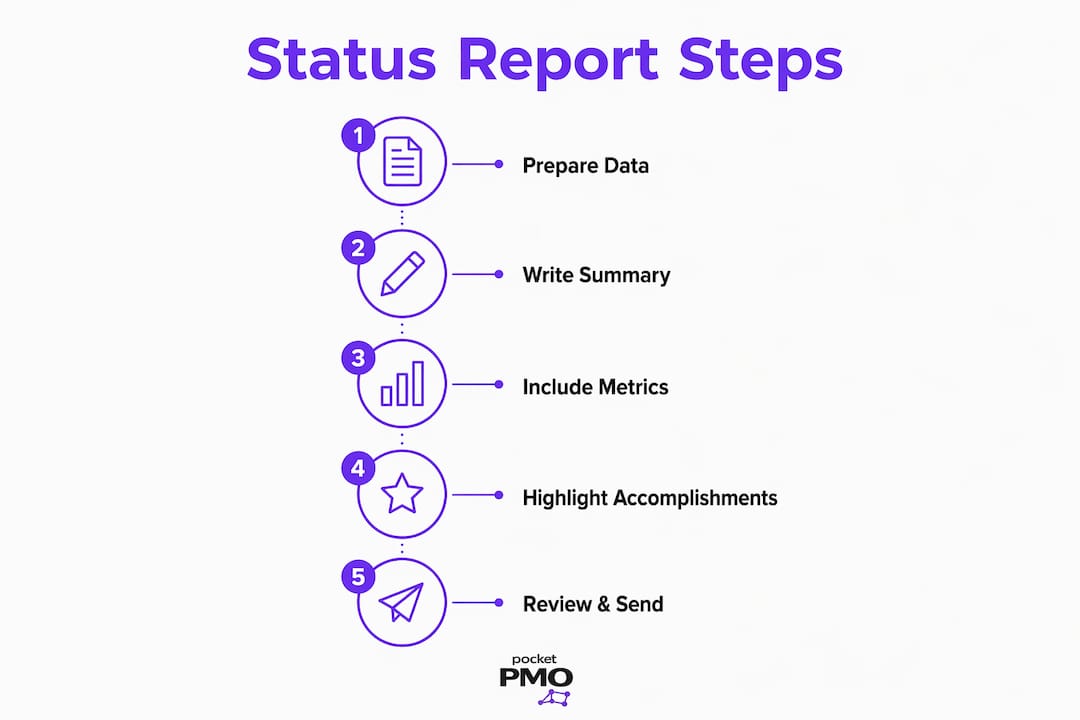
Start by identifying your audience. A board-level sponsor needs a one-page summary with RAG status and financial variance. A programme manager needs dependency flags and resource conflicts. Knowing who reads the report before you write it shapes every decision about what to include and what to cut.
Establish fixed data sources so you are not hunting for information each week. Typical sources include:
- Team standup notes or sprint reviews
- Timesheet and budget tracking tools
- Your project risk register
- Milestone trackers or Gantt charts
- Change request logs
Automating data collection and using structured templates significantly reduces the time spent preparing status reports. Platforms that pull live data into a pre-built template remove the manual aggregation step entirely. That is where tools like Pocketpmo add direct value, auto-populating fields from connected project data so you spend time interpreting, not copying.
The table below shows how different preparation approaches compare on time and reliability.
| Approach | Time to prepare | Reliability |
|---|---|---|
| Manual data collection | High | Variable |
| Structured template with manual input | Medium | Consistent |
| Automated data pull with template | Low | High |
Pro Tip: Use a RAG status template with built-in indicators. Weekly reports completed in 15 minutes are achievable when the template does the formatting work for you.
Phrasing matters during preparation. Write accomplishments as outcomes, not activities. "Ran three stakeholder workshops" is an activity. "Secured sign-off on requirements from three stakeholder groups" is an outcome. That distinction changes how a sponsor reads your progress.
Step-by-step process to write a status report
A repeatable process is the fastest route to consistent, high-quality reports. Follow these steps each reporting cycle.
-
Write the executive summary first. State your RAG status, name one key accomplishment, and flag one key risk. Three sentences maximum. Writing this first forces you to identify what actually matters before you fill in the detail.
-
Insert key metrics. Pull schedule variance, budget variance, and any agreed KPIs. Use numbers, not words. "Three days behind schedule" is clearer than "slightly delayed."
-
List accomplishments with bullet points. Each bullet should name a specific output and confirm its status. Avoid task lists. "Completed" means delivered and accepted, not just worked on.
-
Document current risks and issues. For each risk, state the impact, the probability, and the mitigation action. Risks without mitigations are just complaints. Stakeholders need to know what you are doing about each one.
-
Outline upcoming milestones. List the next two or three milestones with dates and owners. Include any dependencies that could affect delivery. This section is what sponsors read first after the executive summary.
-
Add resource or dependency notes. Flag any constraints that are outside your control. If a third-party supplier is late, say so clearly. Silence on dependencies is a common cause of avoidable surprises.
-
Review for brevity and clarity. Cut any sentence that does not add information. Remove jargon. If a term needs explaining, replace it with plain language.
Common mistakes to avoid:
- Burying the RAG status in the middle of the report
- Using percentage completion without defining what 100% means
- Listing risks without owners or mitigation actions
- Copying last week's accomplishments without updating them
- Writing for the writer rather than the reader
Formatting matters as much as content. Use white space, short paragraphs, and consistent headings. A project status report template with a fixed structure removes formatting decisions from the process entirely, which saves time and keeps reports consistent across a portfolio.
How can status reports reduce meetings and improve team alignment?
Status reports act as a project roadmap, aligning team efforts on milestones and reducing the need for constant check-in meetings. That is not a minor benefit. Fewer meetings mean more time for actual delivery work.
The mechanism is straightforward. When stakeholders can read a clear, current report at any time, they do not need to ask for verbal updates. When teams see the same milestones and blockers in writing, alignment happens through the document rather than through a call. The report cadence you choose, whether daily for Agile sprints or monthly for programme boards, should match the pace at which decisions need to be made.
Effective status reporting also improves decision-making speed. A sponsor who reads a clear Amber status with a named mitigation can approve an action in minutes. The same information delivered verbally in a meeting takes far longer and is harder to act on.
"The best status reports cut through noise by quickly telling the truth about project status, focusing only on essential metrics and updates." James McCann, PMP
Communication tips for different stakeholder groups:
- Sponsors and executives: Lead with RAG status and financial variance. Keep it to one page.
- Programme managers: Include dependency flags, cross-project risks, and resource conflicts.
- Delivery teams: Focus on sprint outcomes, blockers, and next actions. Skip the financial detail.
- Clients: Use plain language, avoid internal acronyms, and confirm agreed milestones clearly.
Tailoring the report to the reader is not extra work. It is the difference between a report that gets read and one that gets ignored. You can explore real-time project reporting approaches that make this tailoring automatic rather than manual.
Key takeaways
Effective status reporting requires a fixed structure, audience-specific content, and a repeatable preparation process to deliver genuine project visibility.
| Point | Details |
|---|---|
| Lead with RAG status | Open every report with a clear Red, Amber, or Green indicator and a three-sentence summary. |
| Write specific accomplishments | Name concrete outputs with confirmed status, not vague activity descriptions. |
| Automate data collection | Use templates and connected tools to cut preparation time to 15 minutes or less. |
| Tailor content to the audience | Sponsors need financials and milestones; delivery teams need blockers and next actions. |
| Replace meetings with reports | A well-written status report removes the need for most routine check-in calls. |
The uncomfortable truth about status reporting
Most project managers treat status reporting as an administrative chore. That is the wrong frame entirely. A status report is a decision-making tool. When you write one badly, you are not just wasting your own time. You are slowing down every person who reads it.
The hardest lesson I have learned is that honesty in reporting is non-negotiable. An Amber status that should be Red protects no one. Sponsors and clients are far more forgiving of bad news delivered early than of surprises delivered late. The report is your opportunity to surface problems while there is still time to act. Use it.
Brevity is equally misunderstood. New project managers often equate length with thoroughness. Experienced ones know the opposite is true. A two-page report that a sponsor reads in full is worth ten pages they skim. The three-sentence executive summary format exists precisely because it forces you to identify what actually matters.
Templates are not a shortcut. They are a discipline. A good project status reporting template removes the cognitive load of formatting decisions and lets you focus entirely on the content. Once you have a template that works, protect it. Consistency across reports builds stakeholder trust over time.
— Danny
Pocketpmo makes status reporting faster and more reliable
Pocketpmo includes built-in status reporting tools designed for project managers who need consistent, high-quality reports without spending hours on preparation.
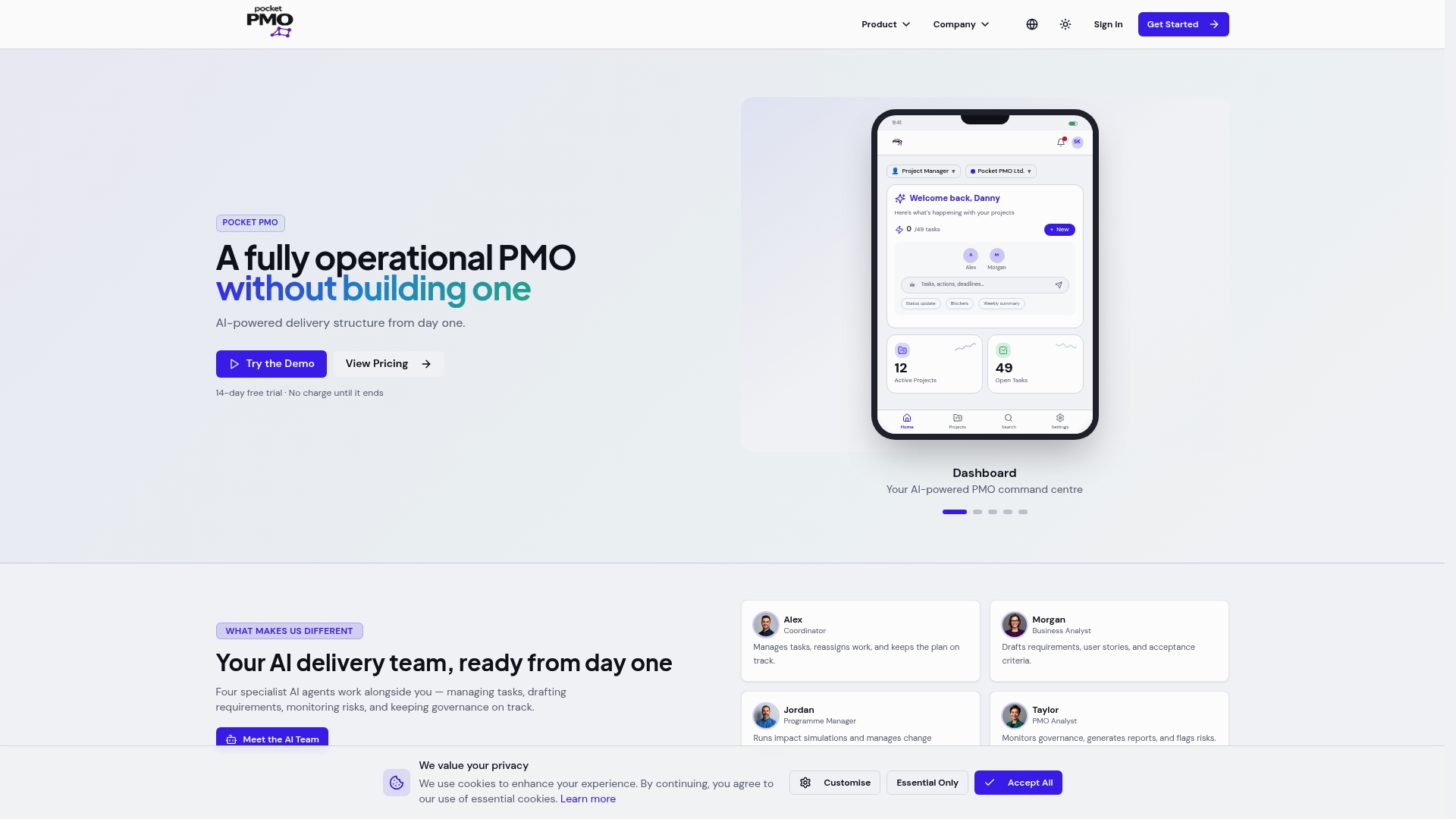
The platform auto-generates RAG status reports from live project data, pulling milestones, risks, and budget variance into a structured template. You review and publish rather than build from scratch. That shift alone recovers significant time each week. Pocketpmo also supports portfolio-level reporting, so programme managers get a consolidated view across multiple projects without manual aggregation. If you want to see how it works in practice, the Pocketpmo platform gives you a fully operational PMO from day one, with reporting built in. You can also review the feature comparison to see how Pocketpmo's reporting capabilities stack up against traditional project management tools.
FAQ
What is a project status report?
A project status report is a concise document that summarises a project's current health, progress, risks, and next steps for stakeholders. It typically includes a RAG status indicator, key metrics, accomplishments, and upcoming milestones.
How often should you send a status report?
Report frequency depends on project sensitivity and stakeholder needs. Agile projects may require daily updates, while most projects suit a weekly or monthly cadence.
What is RAG status in a status report?
RAG stands for Red, Amber, and Green. It is a traffic-light indicator that communicates project health at a glance: Green means on track, Amber means at risk, and Red means off track and requiring immediate attention.
How long should a status report take to write?
A well-structured weekly status report should take no more than 15 minutes to complete when you use a template with built-in RAG indicators and pre-defined sections.
What is the biggest mistake in status reporting?
The most common mistake is writing vague accomplishments and burying the RAG status. Lead with the status indicator and use specific, verifiable outcomes rather than general activity descriptions.