

Project requirements analysis is defined as the systematic process of identifying, documenting, and validating stakeholder needs to ensure project outcomes align with business goals. Poor requirements are a root cause of project failure, according to PMI research, making this process the single most critical phase in project delivery. Get it wrong and you face rework, schedule overruns, and stakeholders who reject the final product. Get it right and every subsequent decision has a solid foundation. This guide covers the core steps, classification methods, validation practices, and practical tools that define effective requirements analysis in 2026, using frameworks including PMBOK 8 and the MoSCoW method.
What is project requirements analysis and why does it matter?
Project requirements analysis is the structured process of eliciting, analysing, documenting, and validating stakeholder needs before project work begins. The industry term used in PMBOK 8 and by the International Institute of Business Analysis (IIBA) is requirements elicitation and analysis, reflecting a deliberate shift away from passive collection towards active facilitation.
The importance of requirements analysis becomes clear when you consider the cost of getting it wrong. Fixing errors at the requirements phase takes minutes. Fixing the same errors post-deployment takes weeks. That cost differential is why experienced project managers treat this phase as non-negotiable, not optional.
Unclear or missing requirements consistently rank as a top factor in project failure. When stakeholders and delivery teams operate from different assumptions, the result is scope creep, budget overruns, and deliverables that miss the mark entirely. Structured requirements analysis prevents that misalignment from taking root.
For project managers, PMO leads, and consultancies, understanding how to manage requirements effectively is not a theoretical exercise. It directly determines whether your project delivers value or generates expensive rework.
What are the main steps in project requirements analysis?
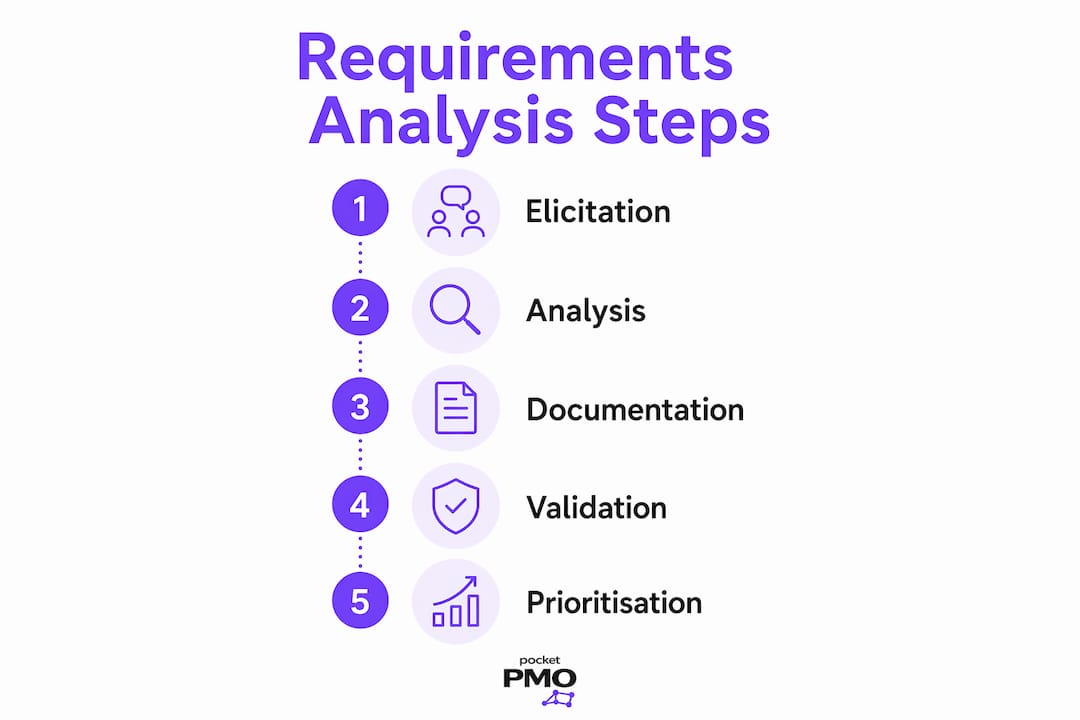
Modern requirements analysis follows four sequential phases, as defined by PMBOK 8 and current business analysis frameworks.
-
Elicitation. This is the process of drawing out stakeholder needs through structured techniques. PMBOK 8 emphasises the shift from collecting to eliciting requirements, recognising that stakeholders often cannot clearly articulate what they need without expert facilitation. Techniques include structured interviews, facilitated workshops, observation, and questionnaires.
-
Analysis. Once captured, requirements are examined for completeness, consistency, and feasibility. Conflicts between stakeholder groups are identified and resolved here. This is where prioritisation methods such as MoSCoW (Must have, Should have, Could have, Won't have) and the Kano model are applied to rank requirements by business value and user impact.
-
Specification. Requirements are formally documented in a structured format. This produces artefacts such as a Software Requirements Specification (SRS) or a Business Requirements Document (BRD), which serve as the authoritative reference for the delivery team.
-
Validation. Stakeholders review and confirm that the documented requirements accurately represent their needs. This step closes the loop between what was heard and what was recorded.
MoSCoW prioritisation is an industry standard for focusing limited resources on critical needs. It reduces the risk of teams spending time on low-value features while high-priority requirements remain unaddressed.
Pro Tip: Run elicitation sessions with a structured agenda and pre-distributed questions. Stakeholders who arrive prepared give you far richer, more specific requirements than those responding cold in a meeting room.

Functional vs non-functional requirements: what is the difference?
Requirements fall into two distinct categories, and missing either leads directly to project failure.
Functional requirements define what the system or product must do. They describe specific behaviours, features, and interactions. Examples include: a user must be able to reset their password via email, the system must generate a monthly financial report, or the platform must support single sign-on via Active Directory.
Non-functional requirements define how the system performs. They cover quality attributes such as security, performance, reliability, and scalability. Examples include: the system must load within two seconds under peak load, all data must be encrypted at rest using AES-256, or the platform must achieve 99.9% uptime.
| Requirement Type | Focus | Example | Risk If Ignored |
|---|---|---|---|
| Functional | System behaviour | Password reset via email | Product does not meet user needs |
| Non-functional | Quality attributes | Page load under two seconds | System fails under real conditions |
| Functional | Data handling | Generate monthly reports | Core business process breaks |
| Non-functional | Security | AES-256 data encryption | Regulatory breach or data loss |
Teams that focus exclusively on functional requirements often deliver products that technically work but collapse under real-world conditions. A login feature that works perfectly for ten users but fails for ten thousand is a non-functional requirements failure, not a functional one.
Pro Tip: Capture non-functional requirements in the same elicitation sessions as functional ones. Treating them as an afterthought almost always results in expensive architectural rework late in the project.
Why is ongoing validation of requirements essential?
Validation and verification are not the same thing, and confusing them is one of the most common mistakes in project delivery. Validation ensures you are building the right system. Verification ensures you are building the system right. A product can pass every technical test and still be rejected by stakeholders because it solves the wrong problem.
Requirements are not static documents. Business priorities shift, regulations change, and stakeholder understanding evolves as the project progresses. IIBA stresses that requirements are living artefacts requiring continuous visibility and alignment with business strategy. Treating them as fixed after the initial sign-off is a reliable path to delivering something nobody wants.
Skipping ongoing validation creates specific, predictable risks. Delivery teams build features based on outdated assumptions. Stakeholders disengage from the process and then reject deliverables at the end. Change requests multiply in the final stages, driving up cost and delay.
Best practices for ongoing requirements management include:
- Schedule regular requirements review checkpoints at each project phase gate.
- Maintain a live Requirements Traceability Matrix (RTM) that links each requirement to its business objective and delivery status.
- Assign a named owner to each requirement so accountability is clear.
- Use change control processes to assess the impact of any requirement modification before approving it.
- Conduct structured walkthroughs with stakeholders after each major delivery milestone to confirm alignment.
For complex or agile-compatible projects, informed decision-making throughout delivery depends on requirements that reflect current business reality, not the assumptions captured six months earlier.
What techniques and tools support effective requirements analysis?
The quality of your requirements analysis depends directly on the techniques and tools you apply. No single method works for every project or stakeholder group.
Elicitation techniques form the foundation. Structured interviews give you depth from individual subject matter experts. Facilitated workshops surface conflicts and build consensus across stakeholder groups. Observation, sometimes called job shadowing, uncovers implicit requirements that stakeholders would never think to mention because they consider them obvious. Questionnaires work well for large, distributed stakeholder groups where individual sessions are impractical.
Modelling tools expose requirements that stakeholders cannot articulate directly. Context diagrams and high-level process maps reveal the boundaries of a system and the interactions between it and external entities. They surface hidden assumptions before those assumptions become expensive scope changes mid-project.
Documentation standards keep teams aligned across the full delivery lifecycle. The two most widely used are:
- Requirements Traceability Matrix (RTM): Links each requirement to its source, its acceptance criteria, and its delivery status. The RTM is the primary tool for ensuring traceability from business need through to tested deliverable.
- Software Requirements Specification (SRS): A structured document that defines all functional and non-functional requirements in sufficient detail for the development or delivery team to act on without ambiguity.
| Tool or Technique | Primary Use | Best For |
|---|---|---|
| Structured interviews | Elicitation | Deep expert knowledge capture |
| Facilitated workshops | Elicitation and analysis | Resolving stakeholder conflicts |
| Context diagrams | Modelling | Defining system boundaries |
| Requirements Traceability Matrix | Documentation | Tracking requirement status |
| MoSCoW prioritisation | Analysis | Ranking by business value |
Modern project management platforms with built-in requirement tracking capabilities reduce the administrative burden significantly. They allow teams to link requirements directly to tasks, risks, and change requests, giving you real-time visibility into whether each requirement is on track. The role of a business analyst in selecting and applying these tools is often the difference between a structured process and an ad hoc one.
Pro Tip: Use effective negotiation techniques when stakeholders present conflicting requirements. Facilitation without negotiation skills leaves priority conflicts unresolved and buried in the documentation.
Key takeaways
Effective project requirements analysis is the foundation of successful delivery, requiring structured elicitation, clear classification, and continuous stakeholder validation throughout the project lifecycle.
| Point | Details |
|---|---|
| Definition and scope | Requirements analysis covers elicitation, analysis, specification, and validation as four sequential steps. |
| Cost of poor requirements | Fixing requirement errors post-deployment takes weeks versus minutes at the analysis phase. |
| Two requirement types | Functional and non-functional requirements must both be captured to prevent product failure. |
| Validation vs verification | Validation confirms you are building the right system; verification confirms you are building it correctly. |
| Requirements are living documents | Treat requirements as dynamic artefacts requiring regular review and alignment with business strategy. |
Requirements analysis is harder than it looks
After working across dozens of projects, the pattern I see most often is this: teams treat requirements analysis as a box-ticking exercise rather than a genuine discovery process. They run one workshop, produce a document, get a signature, and move on. Six months later, they are managing a change request backlog that has doubled the original scope.
The shift that PMBOK 8 makes explicit, from collecting to eliciting, is not just semantic. Stakeholders genuinely cannot tell you what they need in abstract terms. They can tell you what frustrates them, what slows them down, and what they wish worked differently. Your job as the analyst or project manager is to translate those observations into precise, testable requirements. That takes facilitation skill, structured questioning, and the confidence to push back when a stated requirement does not hold up under scrutiny.
The other mistake I see regularly is treating the requirements document as finished once it is signed off. Business strategy changes. Regulatory environments shift. Key stakeholders leave and are replaced by people with different priorities. A requirements document that is not actively maintained becomes a liability, not an asset. The teams that succeed are the ones who build regular review checkpoints into their governance model and treat project risk analysis and requirements management as connected disciplines, not separate workstreams.
My honest advice: invest more time in the elicitation phase than feels comfortable, and build a lightweight but consistent review cadence for the full project duration. The upfront effort pays back many times over.
— Danny
How Pocketpmo supports your requirements management
Requirements analysis generates a significant volume of documentation, decisions, and dependencies. Keeping all of that aligned across a live project is where most teams struggle.
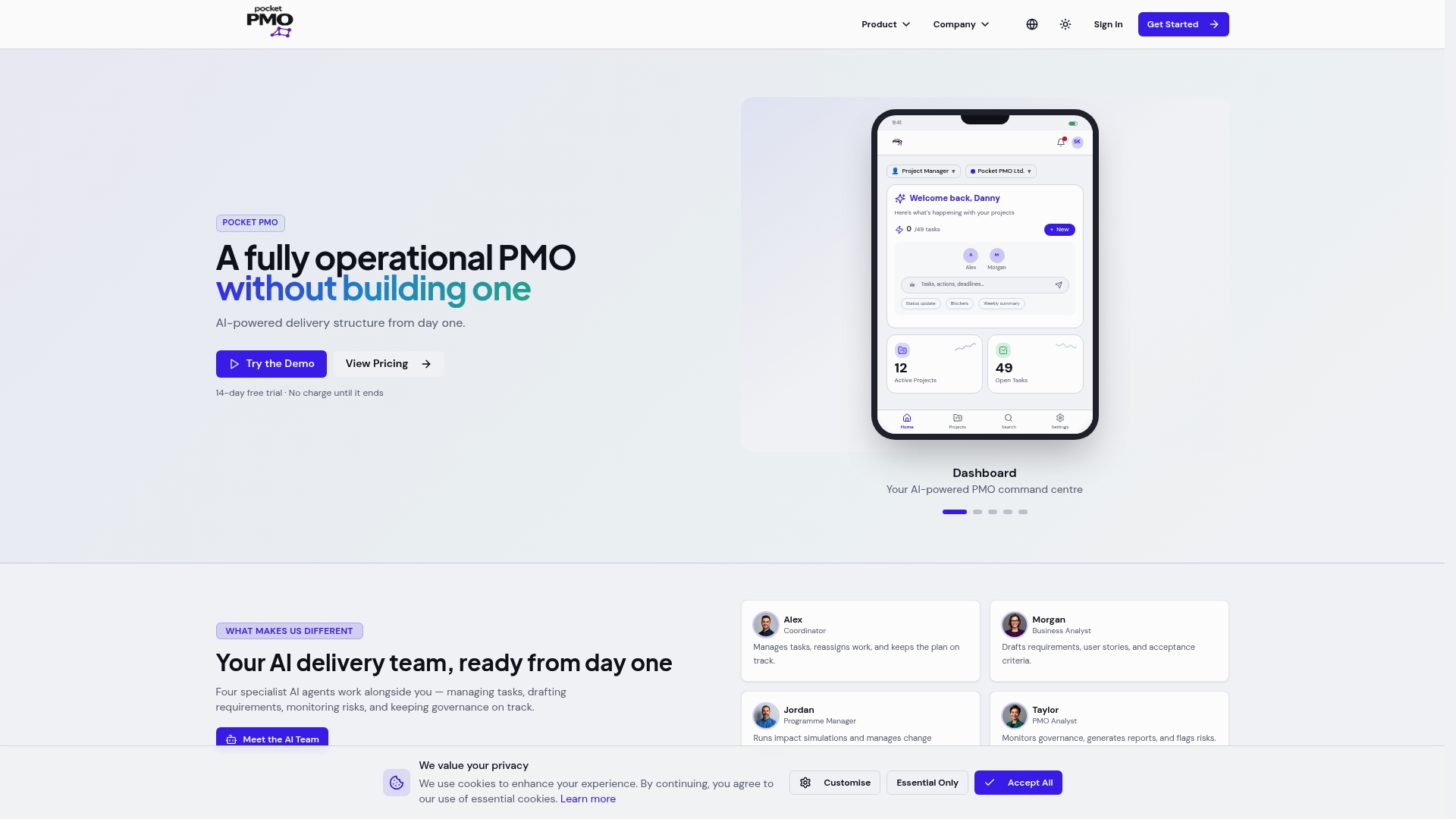
Pocketpmo is built for exactly this challenge. The platform gives you a fully operational PMO from day one, with AI-driven tools to capture, track, and validate requirements alongside your tasks, risks, and change requests. You can link requirements directly to delivery milestones, assign ownership, and monitor status in real time without building a bespoke system from scratch. If you are evaluating your options, see how Pocketpmo compares on features and value against other platforms in the Pocketpmo vs Monday.com comparison. Your requirements deserve a platform that keeps pace with your project.
FAQ
What is the difference between requirements gathering and requirements analysis?
Requirements gathering refers to the collection of stakeholder inputs, while requirements analysis involves examining, classifying, and validating those inputs for completeness and feasibility. PMBOK 8 uses the term elicitation to reflect the active facilitation role required beyond simple gathering.
Why is requirements analysis essential for project success?
Poor requirements are a leading cause of project failure, driving rework, schedule overruns, and stakeholder dissatisfaction. Structured analysis prevents misalignment between what stakeholders need and what the delivery team builds.
What are the main requirements gathering techniques?
The primary techniques are structured interviews, facilitated workshops, observation, and questionnaires. Modelling tools such as context diagrams and process maps are used alongside these to surface implicit requirements.
What is a requirements traceability matrix?
A Requirements Traceability Matrix (RTM) is a document that links each requirement to its business source, acceptance criteria, and current delivery status. It is the standard tool for maintaining end-to-end traceability from business need through to tested deliverable.
How often should requirements be reviewed during a project?
Requirements should be reviewed at each phase gate and after every major delivery milestone. IIBA classifies requirements as living documents, meaning they require continuous alignment with business strategy rather than a single sign-off at project initiation.