

Project lifecycle management is the discipline of governing a project across its structured phases, from initial concept through to formal closure, to maintain alignment with objectives, resources, and stakeholder expectations. Where the project lifecycle describes what phases exist, lifecycle management defines how you actively govern each one. The project's operating system analogy holds well here: it orchestrates resources, establishes a shared language, and ensures every party understands progress, next steps, and success criteria at each stage. Standards such as the PMI PMBOK Guide (8th Edition), frameworks like Waterfall and Agile, and tools including Microsoft Project and Atlassian Jira all operate within this governance structure.
What is project lifecycle management and why does it matter?
Project lifecycle management (PLM) is the active governance of a project through its defined phases, not merely the labelling of those phases. Confusing the two is one of the most common mistakes in the profession. The lifecycle describes the sequence of phases a project passes through. Lifecycle management adds defined inputs, activities, outputs, and agreed exit criteria to each of those phases, turning a structural model into an operational discipline.
The practical consequence is significant. Without active management, phases become loose categories rather than controlled gates. Teams skip deliverables, stakeholders lose visibility, and projects drift from their original objectives. With it, every phase produces a defined output that must meet agreed criteria before the next phase begins. This is the difference between a project that finishes on time and one that quietly expands until it collapses under its own weight.

The importance of project management at this level extends beyond individual projects. Organisations that apply consistent lifecycle governance build institutional knowledge, reduce repeated mistakes, and improve predictability across their entire portfolio. That is the strategic case for treating PLM as a discipline rather than a checklist.
What are the phases of the project lifecycle?
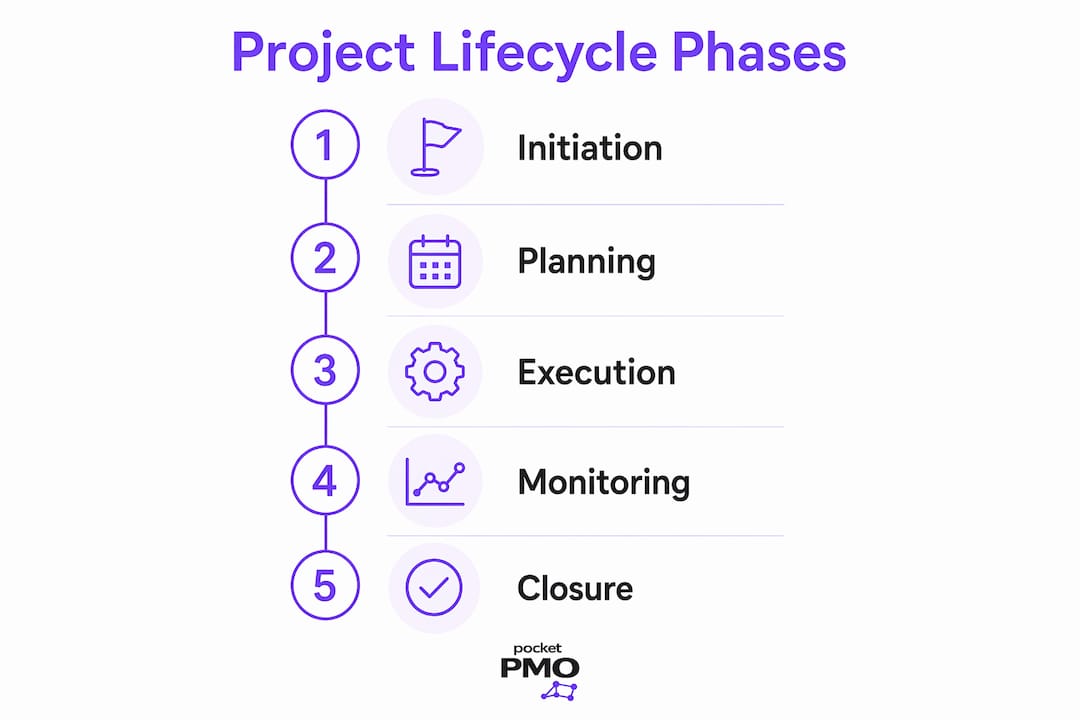
The project management lifecycle typically comprises five phases, each with distinct objectives and deliverables. Understanding what each phase demands prevents the most common failure mode: treating phases as milestones rather than structured work periods.
-
Initiation. The project is defined at a high level. Key activities include feasibility assessment, stakeholder identification, and production of a project charter. The output is formal authorisation to proceed. Tools such as Pocketpmo's project charter template support this phase by capturing scope, objectives, and sponsor sign-off in a single document.
-
Planning. The project roadmap is developed in detail. This covers scope definition, schedule development, resource planning, risk identification, and communication planning. The output is a baseline plan against which all future performance is measured. The project planning process at this stage determines whether the team has a realistic path to delivery or an optimistic fiction.
-
Execution. Tasks are performed, teams are coordinated, and deliverables are produced. This is the phase most people associate with "doing the project," yet it depends entirely on the quality of planning that preceded it. Poor planning produces chaotic execution regardless of team capability.
-
Monitoring and controlling. This phase runs concurrently with execution. It tracks performance against the baseline, identifies variances, and triggers corrective actions. Key activities include status reporting, change control, and risk reviews. The APM Body of Knowledge and PMI process groups both treat this as a continuous activity rather than a discrete phase.
-
Closure. The project is formally completed. Final documentation is settled, deliverables are handed over, and lessons learned are captured. The closure phase is frequently rushed or skipped entirely, which creates what practitioners call "knowledge debt." Lessons go unrecorded, documentation remains incomplete, and the organisation repeats the same mistakes on the next project.
Each phase should end with a gate review, a formal decision point at which the project either proceeds, pivots, or stops. This is where lifecycle management becomes governance rather than administration.
How do project management methodologies align with the lifecycle?
Methodologies provide the "how" to the lifecycle's "what." The PMI PMBOK Guide 8th Edition formalises this by directing practitioners to select a development approach based on project complexity and stability, rather than defaulting to a single method for every engagement.
The three primary approaches map to the lifecycle as follows:
| Methodology | Lifecycle alignment | Best suited for | Key limitation |
|---|---|---|---|
| Waterfall (predictive) | Sequential phases with fixed gates | Stable requirements, regulated industries | Low flexibility for change |
| Agile (adaptive) | Iterative cycles within execution phase | Evolving requirements, product development | Governance overhead at scale |
| Scrum | Sprints nested within execution and monitoring | Software delivery, cross-functional teams | Requires experienced facilitation |
| Hybrid | Predictive planning, adaptive execution | Complex programmes with mixed workstreams | Requires mature governance capability |
Mapping methodologies to lifecycle phases helps balance governance, flexibility, and speed. A construction project with fixed regulatory requirements suits Waterfall's predictive structure. A software product with shifting user needs suits Agile's iterative cycles. A large programme with both elements suits a hybrid model where planning is predictive but delivery is adaptive.
Pro Tip: Do not select a methodology based on organisational preference or team familiarity alone. Assess requirement stability, stakeholder tolerance for change, and regulatory constraints first. The methodology should serve the project, not the other way around.
The practical implication for project managers is that the lifecycle model remains constant whilst the methodology applied within it changes. You always initiate, plan, execute, monitor, and close. How you execute those phases depends on what the project demands.
Why do phase gates and governance matter in lifecycle management?
Stage-gate governance is the mechanism that transforms lifecycle management from a theoretical model into a practical control system. Phase gates are critical decision points at which the project is evaluated for continuation, modification, or termination. They are not administrative checkboxes. They are the moments at which objective evidence replaces intuition.
The benefits of rigorous gate governance include:
- Risk reduction. Gates force a structured review of risks before committing further resources. This is where phase gate governance prevents small problems from becoming programme-level failures.
- Resource alignment. Approving the next phase confirms that budget, people, and tools are available and allocated correctly.
- Scope control. Gates provide a formal moment to assess whether scope has drifted and whether the original business case still holds.
- Stakeholder confidence. Regular gate reviews give sponsors and senior stakeholders visible proof that the project is under control.
"Phase gates prevent projects from progressing based on subjective intuition, ensuring decisions are objective and backed by deliverables and consensus." Lark Suite
Failing a gate is not a failure of the project. It is the governance system working correctly. A project that should be stopped at gate two but is allowed to proceed to gate four wastes resources, demoralises teams, and damages organisational credibility. The discipline to stop or pivot at a gate is one of the clearest indicators of a mature project management culture. For practical guidance on managing project risks within this governance structure, the principles of phase-based risk reviews apply directly.
What are the common challenges in project lifecycle management?
The most persistent challenge is the confusion between having a lifecycle and managing one. Effective lifecycle management requires defined inputs, activities, outputs, and agreed exit criteria for each phase. Many organisations have a lifecycle diagram on a wall and no governance process behind it.
A second major challenge is the neglect of the closure phase. Skipping or rushing closure leads directly to knowledge debt. Lessons learned sessions are cancelled because the team has already moved on. Documentation is left incomplete. The next project manager inherits the same risks without knowing they exist. Using a structured project closure template addresses this directly by making knowledge capture a deliverable rather than an afterthought.
Best practices that consistently improve lifecycle discipline include:
- Define exit criteria for each phase before the project begins, not during it.
- Assign a named owner for each phase gate review, with authority to halt progression.
- Treat lessons learned as a phase deliverable, not an optional retrospective.
- Maintain a live risk register throughout all phases, reviewed at every gate.
- Document scope changes formally at each gate rather than absorbing them informally during execution.
Pro Tip: The planning phase is where most projects are won or lost. Invest disproportionate time here. A plan that takes twice as long to produce will save four times that effort during execution.
Adaptive management is not the absence of discipline. Agile projects still require defined phase objectives, gate reviews, and documented outputs. The format changes; the governance obligation does not.
How to apply lifecycle management for better project outcomes
Applying project lifecycle management in practice means integrating governance with the tools and communication rhythms your team already uses. Modern project management tools improve visibility, accountability, and efficiency across the entire project journey when configured to reflect lifecycle phases rather than just task lists.
Practical steps to apply lifecycle management effectively:
- Configure your project management platform (Microsoft Project, Atlassian Jira, or an AI-powered PMO platform like Pocketpmo) to reflect lifecycle phases as project stages, with gate reviews as milestone events.
- Attach phase-specific documentation templates to each stage so teams know exactly what outputs are required before progression.
- Schedule status reporting at regular intervals during monitoring and controlling, using a consistent format that tracks performance against the baseline plan.
- Build feedback loops into each phase transition. The output of closure feeds directly into the initiation checklist of the next project.
- Use portfolio-level dashboards to track where multiple projects sit within their respective lifecycles simultaneously, enabling resource decisions based on actual phase status rather than subjective updates.
The organisations that apply lifecycle management most effectively treat it as a continuous improvement system. Each completed project produces better inputs for the next one. Over time, this compounds into measurably faster delivery, fewer surprises, and stronger stakeholder confidence.
Key takeaways
Project lifecycle management succeeds when governance, methodology selection, and phase discipline are treated as a single integrated system rather than separate concerns.
| Point | Details |
|---|---|
| Lifecycle vs. lifecycle management | The lifecycle defines phases; management adds governance, exit criteria, and accountability to each one. |
| Phase gates are decision points | Gates enforce objective criteria for continuation, pivot, or termination, reducing risk and resource waste. |
| Methodology follows project needs | Select Waterfall, Agile, or hybrid based on requirement stability and complexity, not organisational habit. |
| Closure is a governance obligation | Skipping closure creates knowledge debt that increases risk and cost on every subsequent project. |
| Tools must reflect the lifecycle | Configure platforms to mirror phases and gates so visibility and accountability are built into daily workflows. |
Why lifecycle discipline separates good projects from great ones
I have reviewed projects at every level of maturity, and the pattern is consistent. Teams that struggle are not short of talent or tools. They are short of discipline at the phase boundaries. The initiation phase is rushed because everyone wants to start building. The closure phase is abandoned because everyone has already moved on. The planning phase is treated as a formality rather than the most consequential work the team will do.
The organisations I have seen deliver consistently well share one habit: they treat each phase gate as a genuine decision point, not a rubber stamp. They ask whether the evidence supports proceeding. They stop projects that no longer serve the business case. They capture lessons learned as a matter of professional obligation, not optional reflection.
The uncomfortable truth is that lifecycle management is not technically difficult. The phases are well understood. The methodologies are documented. The tools exist. What is difficult is the organisational discipline to follow the process when pressure mounts to skip steps and move faster. That discipline is what separates a project culture that learns and improves from one that repeats the same failures at increasing cost.
If you take one thing from this article, make it this: the closure phase is not the end of a project. It is the beginning of the next one.
— Danny
How Pocketpmo supports your project lifecycle
Pocketpmo delivers a fully operational PMO without the overhead of building one from scratch. The platform is built around the project management lifecycle, with real-time dashboards, AI-driven risk analysis, and phase-based governance tools that give you visibility from initiation through to closure. Free templates including the project closure template and project charter template support lifecycle discipline at every stage. Whether you manage a single complex project or a multi-project portfolio, Pocketpmo gives you the governance infrastructure to apply everything covered in this article from day one. Explore the platform and see how it compares at Pocketpmo vs Monday.com.
FAQ
What is the difference between a project lifecycle and project lifecycle management?
The project lifecycle describes the sequence of phases a project passes through, from initiation to closure. Project lifecycle management is the active governance of those phases, adding defined inputs, outputs, exit criteria, and decision gates to each one.
What are the five phases of the project lifecycle?
The five phases are initiation, planning, execution, monitoring and controlling, and closure. Each phase produces defined deliverables and ends with a gate review that determines whether the project proceeds to the next stage.
Why are phase gates important in project management?
Phase gates are critical decision points that enforce objective criteria for continuation, modification, or termination of a project. They replace intuition-based decisions with evidence-backed reviews, reducing the risk of resource waste and scope drift.
Which project management methodology is best for lifecycle management?
The PMI PMBOK Guide 8th Edition recommends selecting a methodology based on project complexity and requirement stability. Waterfall suits stable, predictable projects; Agile suits evolving requirements; hybrid approaches suit programmes with both characteristics.
What happens if the closure phase is skipped?
Skipping closure creates knowledge debt. Lessons learned go unrecorded, documentation remains incomplete, and the organisation repeats avoidable mistakes on future projects. Effective closure is a governance obligation, not an optional activity.