

An outcome-driven PMO is a project management office explicitly designed to measure and deliver business value rather than track project outputs. Where a traditional PMO reports on milestones and budgets, an outcome-driven model holds every initiative accountable to a defined business result. 72% of high-performing organisations prioritise outcomes over outputs, achieving 1.5 times greater long-term success. That figure signals a structural shift in how leading organisations govern projects. For project managers and organisational leaders, understanding outcome-based project management is no longer optional. It is the operating standard for PMOs that want a seat at the strategic table.
What is an outcome-driven PMO and how does it work?
An outcome-driven PMO, also referred to in practice as a Value Delivery Office (VDO), is a governance function that defines project success by benefits realised rather than deliverables completed. It tracks whether a new system actually reduced costs, whether a product launch generated the projected revenue, and whether a process change improved customer satisfaction. The PMO owns those measurements from project initiation through to post-launch review.
The core operating logic is benefits realisation. Before any project begins, the PMO establishes clear, measurable value metrics in partnership with executives. It then monitors those metrics continuously, not just at project close. This post-launch accountability is what separates outcome-focused project management from conventional delivery oversight.
Three structural elements define how the model works in practice. First, success criteria are defined in business terms before the project starts. Second, a baseline is measured so that improvement can be quantified. Third, ownership of realisation is assigned to a named individual or team. Benefits realisation requires these three elements to function. Without all three, measurement becomes reporting theatre rather than genuine accountability.

How does an outcome-driven PMO differ from a traditional PMO?
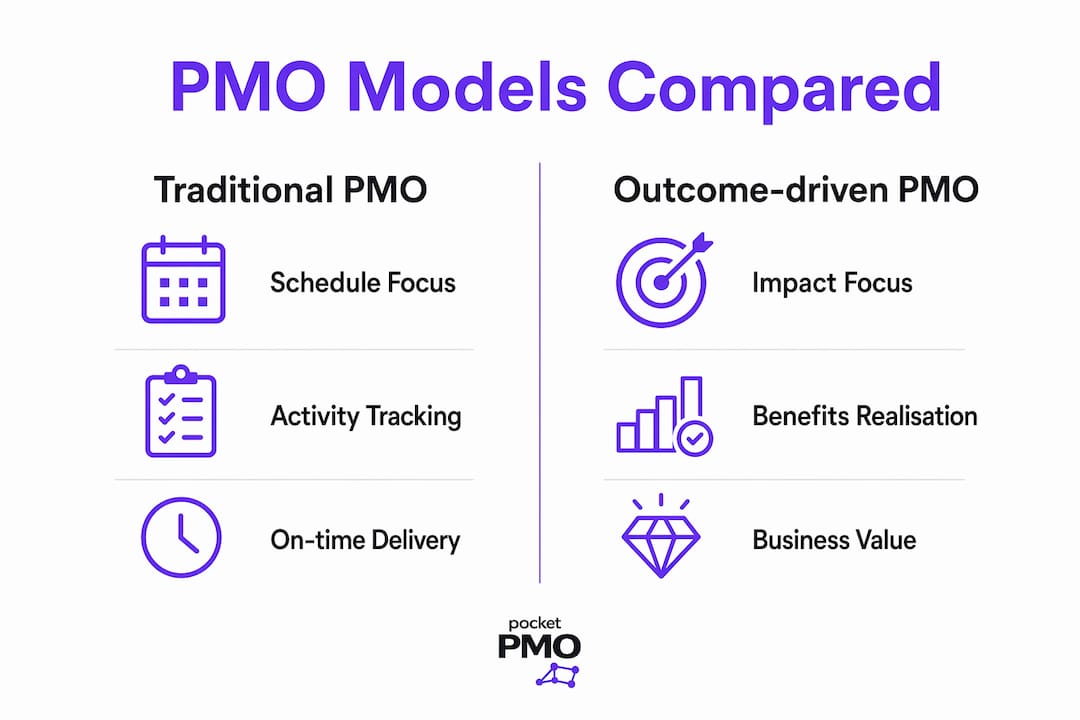
The distinction is not cosmetic. Traditional PMOs measure activity. Outcome-driven PMOs measure impact. The table below captures the most significant contrasts.
| Dimension | Traditional PMO | Outcome-driven PMO |
|---|---|---|
| Primary success metric | On-time, on-budget delivery | Benefits realised as % of planned investment |
| Governance focus | Schedule and milestone adherence | Strategic alignment and value accountability |
| Post-project role | Lessons learned and closure | Continuous benefits tracking for 12+ months |
| Authority structure | Delivery oversight | Joint CFO and CIO mandate |
| PMO perception | Cost centre and admin function | Strategic partner and decision engine |
Outcome-driven PMOs shift focus from measuring project activity and schedule to tracking real business impact and portfolio investment performance over time. That shift changes what the PMO reports, who it reports to, and what authority it holds. A traditional PMO can flag that a project is two weeks late. An outcome-driven PMO can flag that a project is on schedule but will not deliver its projected return, and recommend termination before further capital is wasted.
Governance authority is the critical structural difference. Transformation to an outcome-driven PMO requires joint CFO and CIO sponsorship to gain the authority needed to enforce strategic decisions, including terminating low-value projects. Without that mandate, the PMO can observe but cannot act.
Pro Tip: When making the case for an outcome-driven model internally, frame the conversation around portfolio ROI rather than PMO methodology. CFOs respond to investment performance data, not process redesign proposals.
What are the key benefits of adopting an outcome-driven PMO?
The business case for outcome-focused project management is well evidenced. Organisations that make the transition report gains across portfolio performance, governance quality, and PMO credibility.
- Portfolio ROI. Deploying an outcome-focused PMO correlates to a 20% increase in portfolio ROI and a 25% improvement in organisational performance through post-implementation value measurement. A 20% ROI uplift across a portfolio of ten projects is not marginal. It is the difference between a PMO that pays for itself and one that does not.
- Sustained programme performance. 6 to 12 months after adopting outcome-driven practices, organisations see decreased project escalations and increased alignment, with 8% year-over-year improvement in benefits realisation. That compounding effect means the longer the model is in place, the greater the return.
- Faster, better-informed decisions. Outcome-driven PMO governance emphasises decision frameworks that reduce delays, clarify decision rights, and enable speedy trade-offs between scope and schedule anchored in fixed outcomes. Fewer escalations reach executive level because the PMO has the data and the authority to resolve them earlier.
- PMO credibility. PMOs that track benefits realisation with rigour gain credibility, shifting perception from cost centres to strategic partners. That shift in perception translates directly into budget, headcount, and executive access.
- Capital discipline. Outcome accountability creates a natural mechanism for terminating projects that are unlikely to deliver. Organisations stop funding "zombie" projects, those that are technically active but strategically inert, and reallocate capital to higher-value initiatives.
How can organisations implement an outcome-driven PMO effectively?
Implementation is a phased transformation, not a single process change. The following sequence reflects what works in practice.
-
Define value metrics with executives. Start by agreeing on what success looks like in business terms. Work directly with the CFO and relevant business owners to translate strategic goals into measurable outcomes. Avoid vague targets like "improve efficiency." Use specific metrics: cost per transaction reduced by 15%, customer onboarding time cut from 10 days to 4.
-
Establish a benefits realisation function. Create a dedicated capability within the PMO responsible for tracking outcomes post-launch. This function monitors actual versus projected value, owns escalation protocols, and reports directly to executive sponsors. Continuous value monitoring with escalation protocols enables early risk detection and swift capital reallocation, which is crucial for sustaining strategic alignment.
-
Set pivot rules before projects begin. Agree upfront on the conditions under which scope can change, a project can be paused, or a project should be terminated. Outcome-driven PMOs must set strict pivot rules to manage scope flexibility against fixed outcome targets, facilitating decision discipline and objective trade-offs. Without these rules, every scope change becomes a political negotiation rather than a data-driven decision.
-
Secure joint CFO and CIO sponsorship. Authority is non-negotiable. The PMO needs the mandate to act on its findings, not just report them. Effective outcome-driven PMOs embed joint CFO and CIO mandates for authority, ensuring the power to terminate non-performing projects and enforce value discipline.
-
Track benefits for at least 12 months post-launch. Successful implementation includes continuous benefits tracking for at least 12 months after project launch to prevent reversion to old practices. Most value leakage happens in the months after go-live, when attention moves to the next initiative and no one is watching the numbers.
-
Address cultural resistance directly. Cultural resistance is common when shifting PMO focus, but framing outcome measurement as an early warning tool helps engage stakeholders and ease the transition. Position the PMO as a support function that surfaces problems early, not a policing body that assigns blame.
Pro Tip: Do not attempt a full portfolio transformation in year one. Pilot the outcome-driven model on two or three high-visibility projects, demonstrate the ROI improvement, and use those results to build the case for wider adoption.
For practical guidance on PMO change management, the cultural and governance dimensions of this transition are explored in depth.
What measurement frameworks and tools support outcome-driven PMOs?
Measurement is the operational core of outcome-based project management. Without a clear framework, outcome tracking collapses into subjective reporting.
Three terms need to be precise before any framework is built. Outputs are the deliverables a project produces: a new system, a trained team, a launched product. Outcomes are the changes in behaviour or performance that those outputs enable: faster processing, higher conversion, lower attrition. Benefits are the quantified business value of those outcomes: £2.4m in cost savings, 18% revenue growth. Most PMOs measure outputs. Outcome-driven PMOs measure benefits.
The following metrics form the core of a functioning measurement framework.
| Metric | What it measures | Target benchmark |
|---|---|---|
| Benefits realised % | Actual value vs planned investment | >80% within 12 months post-launch |
| Strategic alignment % | Projects mapped to corporate objectives | >90% of active portfolio |
| Decision cycle time | Average time from issue raised to decision made | Reduction of 30%+ vs baseline |
| Escalation rate | % of projects requiring executive intervention | Declining quarter-on-quarter |
| Portfolio ROI | Return on total project investment | 20%+ above pre-transformation baseline |
Baseline measurement is not optional. You cannot demonstrate a 20% ROI improvement if you did not record what ROI looked like before the change. Establish baselines for every metric before the transformation begins. Review them quarterly for the first year, then monthly once the model is stable.
PMOs gain credibility and strategic partnership when shifting metrics focus from "projects on schedule" to "benefits realised as a percentage of planned investment." That single metric change reframes every conversation the PMO has with the board. For a practical starting point on PMO governance decisions, structured frameworks make the transition measurable from day one.
Platforms like Pocketpmo support this measurement layer directly, with real-time portfolio dashboards, AI-driven risk analysis, and benefits tracking built into the governance workflow. The platform removes the manual overhead of maintaining measurement frameworks across multiple projects simultaneously.
Why outcome-driven transformation is harder than it looks
The process design for an outcome-driven PMO is not the difficult part. The difficult part is the uncomfortable truth it surfaces. When you start measuring benefits realised rather than milestones hit, some projects that looked successful on paper turn out to have delivered very little. That is politically sensitive. Sponsors who championed those projects do not enjoy seeing the data.
In my experience, the organisations that stall on outcome-driven transformation are not failing because of technical gaps. They are failing because no one with sufficient authority is willing to act on what the measurements reveal. Joint CFO and CIO sponsorship is not a governance formality. It is the mechanism that gives the PMO permission to say "this project is not delivering" and have that statement result in a decision rather than a meeting.
The cultural shift matters as much as the structural one. Transitioning PMOs to value-driven offices is an operational evolution that needs persistent cultural change and strategic partnerships with CFOs. Project teams that have spent years being measured on delivery speed need time to internalise a different definition of success. That transition requires consistent messaging from leadership, not just a new dashboard.
The PMOs I have seen make this work fastest are the ones that position themselves as an early warning system. They are not there to catch people out. They are there to surface problems before they become expensive. That framing changes the conversation entirely, and it is the single most effective way to reduce resistance during the transition.
— Danny
How Pocketpmo delivers an outcome-driven PMO from day one
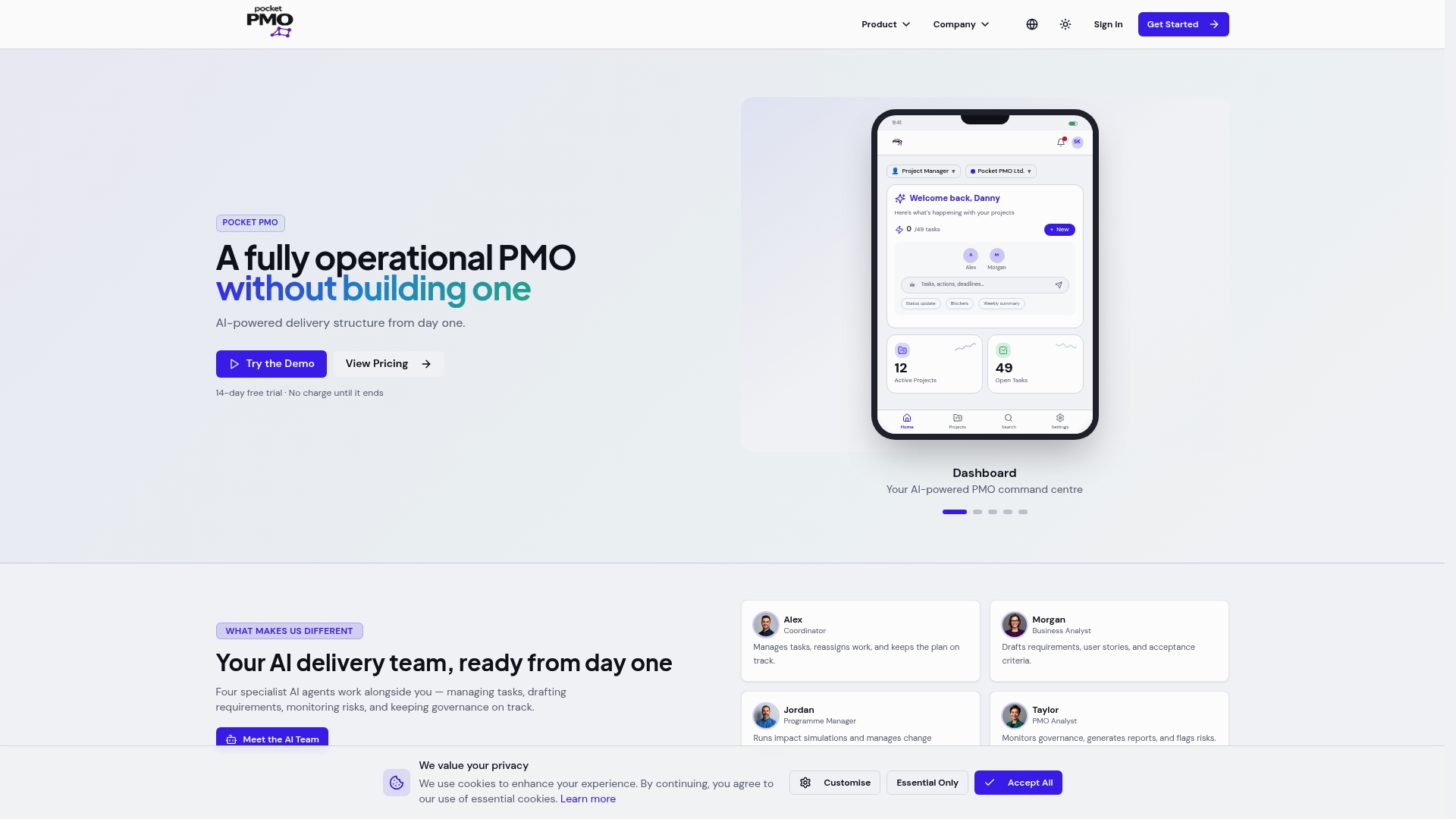
Pocketpmo is built specifically for organisations that want the governance, measurement, and decision frameworks of an outcome-driven PMO without the time and cost of building one internally. The platform includes real-time portfolio dashboards, AI-driven risk analysis, benefits tracking workflows, and change request management, all configured to support outcome-based project management from the moment you launch.
You can track benefits realised against planned investment, monitor strategic alignment across your portfolio, and manage escalation protocols without building a single spreadsheet. Explore the full PMO platform to see how Pocketpmo supports every stage of the outcome-driven model, from value metric definition through to post-launch benefits monitoring. You can also review the platform features in detail to match capabilities to your specific governance needs.
Key takeaways
An outcome-driven PMO delivers measurable business value by tracking benefits realised, not just deliverables completed, and requires executive mandate, clear metrics, and post-launch accountability to succeed.
| Point | Details |
|---|---|
| Definition is precise | An outcome-driven PMO measures benefits realised against planned investment, not milestone completion. |
| Authority is non-negotiable | Joint CFO and CIO sponsorship is required to enforce value discipline and terminate non-performing projects. |
| ROI gains are documented | Adopting an outcome-focused model correlates to a 20% portfolio ROI increase and 25% performance improvement. |
| Measurement needs a baseline | Establish output, outcome, and benefit baselines before transformation begins to quantify progress accurately. |
| Culture drives adoption | Framing the PMO as an early warning system, not a policing body, reduces resistance and accelerates transition. |
FAQ
What is an outcome-driven PMO in simple terms?
An outcome-driven PMO is a project management office that measures success by the business value a project delivers, not by whether it finished on time or on budget. It tracks benefits realised against planned investment throughout and after project delivery.
How long does it take to implement an outcome-driven PMO?
Most organisations see measurable improvements in project escalation rates and strategic alignment within 6 to 12 months of adopting outcome-driven practices, with benefits realisation improving by approximately 8% year-on-year thereafter.
What authority does an outcome-driven PMO need?
It requires joint CFO and CIO sponsorship to hold the mandate for enforcing strategic decisions, including pausing or terminating projects that are not on track to deliver their projected value.
How is an outcome-driven PMO different from a traditional PMO?
A traditional PMO tracks schedule, budget, and delivery milestones. An outcome-driven PMO tracks whether projects are generating the business results they were funded to produce, and acts on that data with governance authority.
What tools support outcome-driven PMO measurement?
Platforms with real-time portfolio dashboards, benefits tracking workflows, and AI-driven risk analysis, such as Pocketpmo, support the continuous measurement and escalation protocols that outcome-driven governance requires.