

Scalable project management is defined as the ability to expand and adapt project processes to handle greater complexity and volume without losing control or value focus. As organisations face mounting pressure to deliver more with less, the gap between strategy and execution widens. 81% of project professionals observe increased project complexity, with 37% noting a significant rise. That figure signals a structural challenge, not a temporary one. Frameworks such as PMI's M.O.R.E. elements, PMO governance models, and automation platforms like FlexiProject exist precisely because traditional approaches cannot absorb this level of complexity without breaking down.

Why scalable project management matters for complex organisations
The business case for scaling project management well is stark. Teams that manage complexity effectively achieve an 88% project success rate, compared to just 14% for those that do not. That is a sixfold difference driven entirely by how well an organisation adapts its processes to the demands placed on them.
The benefits of scalable project management extend well beyond raw success rates. When your delivery model grows with project complexity, you gain:
- Strategic alignment. Projects stay connected to organisational goals even as scope expands, reducing the drift that causes late-stage failures.
- Resource optimisation. Scalable governance prevents duplication of effort across portfolios and surfaces conflicts before they become crises.
- Improved stakeholder confidence. Consistent reporting and clear accountability structures give sponsors the visibility they need to make timely decisions.
- Better risk management. Scenario planning and predictive governance replace reactive fire-fighting with structured anticipation.
Only half of projects meet modern success definitions, with 13% outright failures and 37% delivering only partial value. That means the majority of project investment is leaking value somewhere between strategy and execution. Scalability is the mechanism that seals those leaks.
Pro Tip: Before investing in new tools, audit whether your current projects are measured on outcomes or activities. If your dashboards track task completion rather than value delivered, you are optimising the wrong thing.
How do scalable strategies differ from traditional project management?
Traditional project management focuses on task tracking, activity volume, and milestone compliance. It works well for contained, predictable projects. It fails when complexity rises, interdependencies multiply, and the environment shifts faster than the plan can accommodate.
| Dimension | Traditional approach | Scalable approach |
|---|---|---|
| Primary focus | Task completion and milestones | Outcome delivery and value realisation |
| Governance model | Static risk registers and status reports | Predictive complexity handling and dynamic reassessment |
| PMO role | Administrative coordination | Strategic execution hub governing tradeoffs |
| Data use | Periodic manual reporting | Real-time analytics and automated workflows |
| Methodology | Single fixed framework | Hybrid models blending Agile and Waterfall |
The PMO distinction in that table deserves particular attention. Modern PMOs act as execution hubs connecting project execution to strategy by governing tradeoffs, aligning sponsors, and coordinating dependencies. PMO-equipped organisations report a 63% perceived success rate in complex projects, compared to 57% for those without. That gap grows as project portfolios scale.
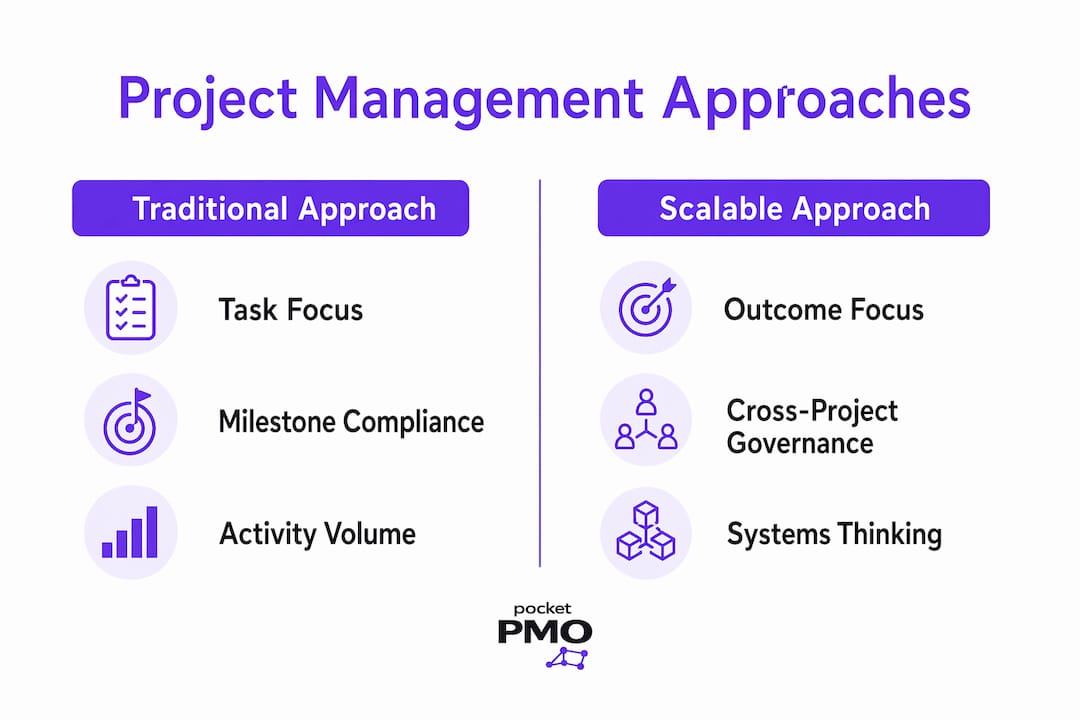
Scalable methods also demand systems thinking. Effective governance in complex projects requires managing the interrelations of people, technology, and external forces rather than solely tracking individual deliverables. This shift from linear tracking to relational oversight is the defining characteristic that separates scalable practice from traditional project management.
Pro Tip: If your PMO spends more time producing reports than resolving cross-project dependencies, it is functioning as an administrator rather than a strategic asset. Reorient its mandate toward tradeoff governance.
Which frameworks and strategies deliver the best results at scale?
The evidence points to four consistent behaviours that separate high-performing organisations from the rest. PMI's M.O.R.E. framework captures them precisely:
- Manage perceptions. Actively shape how stakeholders understand project progress, risks, and trade-offs. Misaligned expectations are a leading cause of perceived failure even when delivery is technically sound.
- Own success. Define what success means beyond traditional metrics such as time, cost, and scope. Applying all four M.O.R.E. elements raises the Net Project Success Score from 27 to 94. That is not a marginal improvement; it is a transformation in delivery confidence.
- Relentlessly reassess. Build structured checkpoints to re-evaluate assumptions, dependencies, and priorities as complexity evolves. Only 20% of teams use scenario planning consistently, yet it measurably improves readiness for complexity. That adoption gap represents a significant competitive advantage for organisations willing to invest in it.
- Expand perspective. Bring in external viewpoints, cross-functional input, and horizon scanning to avoid the tunnel vision that causes strategic drift.
Beyond M.O.R.E., blending Agile and Waterfall approaches supports scalability by combining structure with flexibility across complex programmes. Hybrid models provide centralised oversight while preserving the adaptability teams need to respond to change. Platforms like FlexiProject operationalise this by enabling automated task approval and KPI reporting, removing the manual overhead that slows scaling efforts. You can explore how PMO delivery strategies translate these frameworks into daily practice across different organisational contexts.
What pitfalls should leaders avoid when scaling project management?
Scaling project management fails in predictable ways. Recognising these patterns before they take hold saves significant time and budget.
- Measuring activity instead of outcomes. Adding dashboards and trackers creates the illusion of control while progress stalls. When teams optimise for task completion rather than stable handovers and value realisation, the project looks busy but delivers little.
- Adding reporting layers without resolving dependencies. More status updates do not fix misaligned workstreams. They generate busywork and delay the conversations that actually unblock progress.
- Assuming more resources equal faster delivery. Adding headcount to a complex project with unclear governance typically increases coordination overhead rather than output. Structure must precede scale.
- Ignoring human and organisational complexity. Stakeholder misalignment, governance gaps, and unclear accountability structures are the most common causes of scaled project failure. Technology cannot compensate for these gaps.
Pro Tip: When a project is running late, resist the instinct to add more people or more reporting. First, map the dependency chain and identify where handovers are breaking down. That is where the real delay lives.
The strategy-execution gap is the most consequential pitfall of all. Organisations that treat project management as a delivery mechanism rather than a strategic function consistently underperform. Closing that gap requires reframing project management as the connective tissue between organisational intent and operational reality.
How can organisations implement scalable project management in practice?
Practical implementation follows a clear sequence. The organisations that scale well do not attempt everything at once. They build capability in layers.
- Establish or empower a PMO as a strategic execution hub. Give it authority over governance, tradeoff decisions, and dependency coordination. A PMO that only reports cannot drive the alignment that scaling demands. Explore PMO use cases to understand how this function operates across different organisational structures.
- Adopt M.O.R.E. and scenario planning systematically. 39% of high performers establish shared success understanding compared to 30% of low performers. That 9-point gap compounds across a portfolio. Codify what success means for each project before delivery begins.
- Adopt an automation-first platform. Remove manual reporting burdens so your team focuses on decisions rather than data collection. Real-time data flow and integrated workflows are not luxuries at scale; they are prerequisites.
- Invest equally in people and technology. AI tools paired with human strengths such as communication, judgement, and adaptability improve project success by 17 points. Technology without leadership capability delivers marginal gains.
- Build continuous reassessment into governance cadences. Schedule structured reviews that question assumptions, not just progress. Complexity evolves; your governance model must evolve with it.
For teams managing multiple concurrent initiatives, the discipline of managing multiple projects effectively becomes the foundation on which scalable delivery is built.
Pro Tip: Start your scaling effort with a governance audit, not a tool purchase. Identify where decisions stall, where dependencies go unmanaged, and where accountability is unclear. Tools amplify good governance; they cannot replace it.
Key takeaways
Scalable project management succeeds when organisations combine outcome-focused governance, structured frameworks like M.O.R.E., and automation-enabled PMOs to close the gap between strategy and delivery.
| Point | Details |
|---|---|
| Success rate differential | Teams managing complexity well achieve 88% success vs 14% for those that do not. |
| M.O.R.E. framework impact | Applying all four M.O.R.E. elements raises the Net Project Success Score from 27 to 94. |
| PMO as strategic hub | PMO-equipped organisations report 63% perceived success in complex projects vs 57% without. |
| Avoid activity measurement | Tracking tasks instead of outcomes creates the illusion of progress while value leaks away. |
| AI plus human capability | Combining AI tools with leadership skills improves project success by 17 points. |
The uncomfortable truth about scaling project management
I have worked with enough leadership teams to know that the hardest part of scaling project management is not the technology. It is the mindset shift. Most organisations reach for a new platform when projects start failing at scale, and most of the time, the platform is not the problem.
The pattern I see repeatedly is this: a leadership team measures project health by the volume of activity. Meetings held, tasks logged, reports submitted. It feels like control. It is not. Measuring busywork instead of value realisation causes fragmented progress and coordination overload. The dashboards multiply; the outcomes do not.
What actually works is far less glamorous than most technology vendors suggest. It is defining success before you start. It is giving your PMO real authority rather than a reporting function. It is building scenario planning into your governance calendar rather than treating it as a crisis response tool. These are leadership decisions, not software features.
The growing pressure to integrate AI into project delivery is real, and the PMI data on AI plus human capability is compelling. But I would caution against treating AI adoption as a scaling strategy in itself. AI amplifies the quality of your governance. If your governance is weak, AI will surface your problems faster. That is useful, but it is not the same as solving them.
The organisations that scale project management well are not the ones with the most sophisticated tools. They are the ones that have made a deliberate decision to measure what matters, govern what is complex, and reassess what they think they know. That is a cultural commitment, and it requires ongoing evolution rather than a one-off transformation.
— Danny
How Pocketpmo supports your scaling ambitions
Pocketpmo delivers a fully operational PMO without the cost or complexity of building one from scratch. The platform integrates real-time dashboards, AI-driven risk analysis, and automated workflows to give your organisation the governance infrastructure that scaling demands. It connects with your existing ERP, CRM, and HR systems, so data flows where decisions are made rather than sitting in isolated spreadsheets.
For organisations managing complex multi-project environments, Pocketpmo supports hybrid methodology delivery, scenario planning, and continuous reassessment through predictive analytics. You get the strategic execution capability of an enterprise PMO from day one. If you are evaluating your options, the Pocketpmo vs Monday.com comparison sets out exactly where the platform's AI-first approach delivers a measurable difference for teams scaling their delivery.
FAQ
What is scalable project management?
Scalable project management is the ability to expand and adapt project processes, governance, and tools to handle greater complexity and volume without losing control or value focus. It differs from traditional project management by prioritising outcome delivery and systems thinking over task tracking.
Why do complex projects fail at scale?
Nearly one-third of complex projects fail to achieve their full intended benefits, most commonly because organisations measure activity rather than outcomes and lack governance structures capable of managing interdependencies at scale.
What is PMI's M.O.R.E. framework?
M.O.R.E. stands for Manage perceptions, Own success, Relentlessly reassess, and Expand perspective. Applying all four elements consistently raises the Net Project Success Score from 27 to 94, according to PMI research.
How does a PMO support scalable delivery?
A PMO functions as a strategic execution hub that governs tradeoffs, aligns sponsors, and coordinates cross-project dependencies. PMO-equipped organisations report higher perceived success rates in complex projects and are better positioned to manage portfolio-level complexity.
When should an organisation invest in scalable project management tools?
Invest in tooling after establishing clear governance and outcome definitions. Technology amplifies existing governance quality, so organisations that adopt automation-first platforms with strong PMO structures in place see the greatest gains in delivery performance.