
Most projects don't fail because teams stop caring. They fail because warning signs go unnoticed until it's too late to course-correct. Routine status reports tell you where a project has been, not where it's heading. Organisations with mature project monitoring complete 89% of projects successfully, compared to just 36% for those with immature practices. That gap isn't down to talent or budget. It's down to visibility. In this article, you'll learn what project health monitoring actually means, why it drives better outcomes, how to apply it in practice, and how AI is reshaping the way PMOs stay ahead of risk.
Table of Contents
- What is project health monitoring?
- Why project health matters: outcomes, visibility, trust
- How project health monitoring works in practice
- Advanced project monitoring: AI-driven insights and portfolio optimisation
- Common pitfalls and how to avoid them
- A fresh perspective: what most guides miss about project health
- Looking for simpler, smarter project health monitoring?
- Frequently asked questions
Key Takeaways
| Point | Details |
|---|---|
| Visibility prevents project failure | Monitoring project health surfaces risks early, enabling proactive responses before issues escalate. |
| Stakeholder trust builds with transparency | Data-driven monitoring and clear KPIs reassure sponsors and stakeholders while improving alignment. |
| AI boosts PMO decision-making | AI insights maximise portfolio performance by forecasting risks, optimising resources, and streamlining reporting. |
| Culture matters as much as data | Embedding monitoring requires leadership buy-in, accurate data, and a safe environment for raising concerns. |
What is project health monitoring?
With the importance of effective monitoring in mind, let's explore what defines project health monitoring and how it stands apart from routine project reporting.
Project health monitoring is the continuous assessment of a project's performance across four core dimensions: cost, schedule, scope, and risk. Unlike a status report, which captures a snapshot at a fixed point in time, health monitoring generates an ongoing signal. It tells you not just what has happened, but what is likely to happen next if nothing changes.
Early detection of issues like cost overruns, schedule delays, and emerging risks shifts your team from reactive firefighting to proactive management. That distinction matters enormously at portfolio scale.
The most widely used tools in project health monitoring include:
- RAG status indicators (Red, Amber, Green): a quick visual summary of overall project condition
- Earned value management (EVM): links cost and schedule performance to actual work completed
- Cost variance (CV) and schedule variance (SV): measure deviation from plan in financial and time terms
- Real-time dashboards: consolidate multiple data streams into a single, readable view
- Health check reviews: structured periodic assessments conducted by the project team or PMO
For a deeper look at how RAG status indicators support project tracking, they work by assigning a colour to each project dimension. Green means on track. Amber signals a developing concern that needs attention. Red flags a critical issue requiring immediate escalation.
| Feature | Status reporting | Health monitoring |
|---|---|---|
| Frequency | Periodic (weekly/monthly) | Continuous or near real-time |
| Focus | Past performance | Current state and future risk |
| Output | Report | Actionable insight |
| Response | Reactive | Proactive |
| Scope | Single project | Portfolio-wide |
Explore AI project tracking strategies to see how these foundations connect with modern tooling, or review the project health features available within dedicated PMO platforms.
Why project health matters: outcomes, visibility, trust
After clarifying the fundamental techniques and frameworks, it's vital to see what effective health monitoring achieves for your organisation, team, and stakeholders.
The numbers are unambiguous. Organisations with mature monitoring complete 89% of projects successfully versus only 36% for those with immature processes. That's not a marginal improvement. It's the difference between a reliable delivery function and a persistent source of organisational frustration.
| Monitoring maturity | Project success rate |
|---|---|
| Mature practices | 89% |
| Immature practices | 36% |
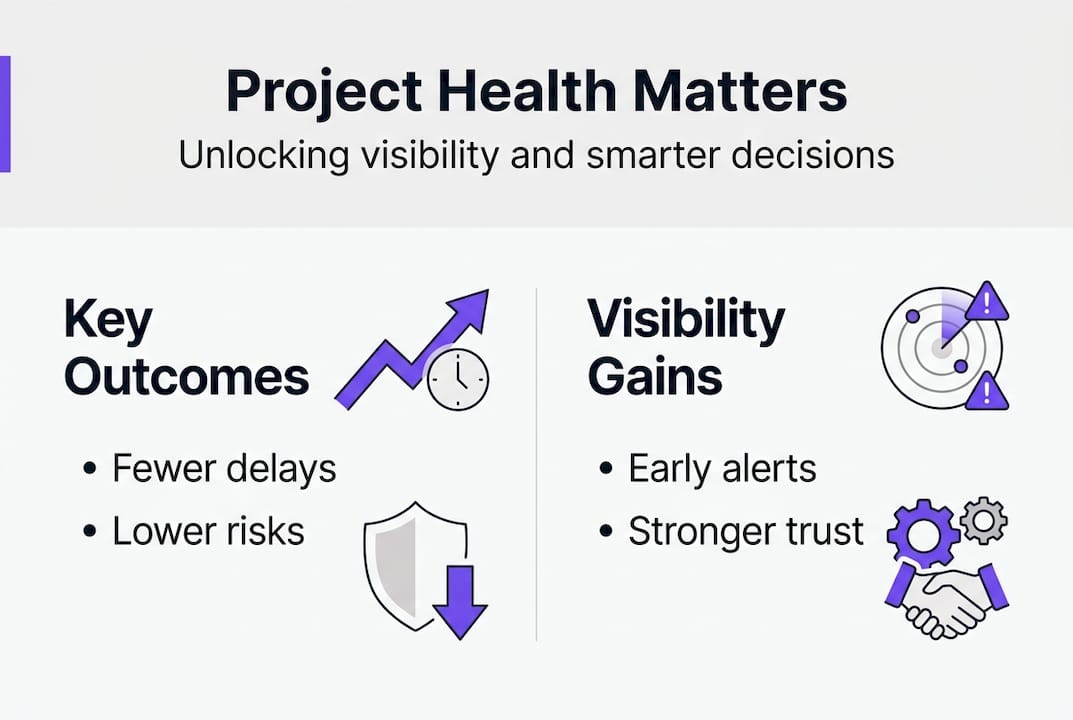
Healthy monitoring drives three interconnected outcomes:
- On-time, on-budget delivery: By catching deviation early, teams can recalibrate resources, timelines, or scope before small slippages become unrecoverable overruns.
- Stakeholder confidence: Transparent, accurate health data builds trust. When executives and clients can see real performance trends, they stop relying on gut instinct and start making decisions based on evidence.
- Risk reduction: Early amber or red signals give decision-makers time to act. Waiting for a formal report cycle means opportunities for intervention are often already gone.
"When stakeholders can see honest, timely health data, they become partners in solving problems rather than recipients of bad news."
Consider the real-world use cases where late identification of risk cost organisations significantly in rework, reputational damage, and contract penalties. In each scenario, the issue existed weeks or months before it became visible. Health monitoring closes that gap.
For PMOs managing several concurrent projects, multi-project risk monitoring adds another layer of value. Portfolio-wide visibility lets you compare project health side by side, prioritise interventions, and allocate resources to where they're needed most urgently.
How project health monitoring works in practice
Knowing why monitoring matters, let's break down how you can apply practical steps to embed it into your daily project management routines.
Effective monitoring isn't just about having a dashboard. It requires discipline, structure, and regular follow-through. Here's how to do it well:
- Gather and validate data: Collect accurate, up-to-date figures for cost, schedule, scope, and risk. Inaccurate data produces misleading signals. Assign ownership so one person is accountable for each data stream.
- Apply RAG indicators: Assign red, amber, or green status to each dimension based on agreed thresholds. Document what triggers each colour change so decisions are consistent, not subjective.
- Use dashboards to consolidate: Bring all indicators into one view. A well-designed dashboard reduces time spent chasing updates and makes deviation visible at a glance.
- Review at regular intervals: Weekly or bi-weekly reviews are the standard for active projects. Sporadic monitoring defeats the purpose. Project health monitoring tracks cost variance, schedule variance, and ROI projection, which means you can identify overspending trends before they become critical.
- Escalate amber and red early: Don't wait for certainty before escalating. Amber status is a signal to investigate and engage decision-makers, not a reason to monitor silently.
- Document trends, not just incidents: A single red flag might be an anomaly. A pattern of amber flags across three consecutive reviews signals a structural issue that needs a strategic response.
Use risk matrices and dashboards to structure your escalation logic, and pair them with a sound risk management guide to define what constitutes a material risk at each project stage.
Pro Tip: Set your amber threshold conservatively. It's far better to investigate a false alarm than to miss a genuine early warning signal.
Advanced project monitoring: AI-driven insights and portfolio optimisation
While basic monitoring addresses single-project risks, modern PMOs can elevate visibility and value by harnessing AI for decision-support across the whole project portfolio.
Portfolio-level visibility enables resource reallocation and AI-driven predictive insights in mature organisations. That's a shift from descriptive monitoring, which tells you what happened, to predictive monitoring, which tells you what's likely to happen next.
AI-powered monitoring capabilities now include:
- Trend forecasting: AI analyses historical and live cost, schedule, and risk data to project likely outcomes weeks ahead, giving teams time to intervene.
- Anomaly detection: Automated alerts flag unusual patterns, such as a sudden cost spike or a scope creep trend, before they appear in a manual review.
- Resource optimisation: Live health signals help PMO leaders reallocate capacity across projects based on where pressure is building, not where it was expected to be.
- Automated health checks: Routine monitoring tasks are handled automatically, freeing project managers to focus on decision-making rather than data collection.
- Portfolio dashboards: A consolidated view of all project health scores enables rapid, evidence-based prioritisation at leadership level.
The AI-powered monitoring strategies that deliver the most value are those aligned to specific portfolio risks, not generic templates. Explore PMO launch solutions if you're looking to build this capability from day one.
Pro Tip: Avoid analysis paralysis by focusing on three to five predictive metrics that directly correlate with your portfolio's most common failure modes.
Common pitfalls and how to avoid them
No approach is foolproof. Let's address common mistakes and how to truly embed project health monitoring for sustainable success.
Even well-intentioned monitoring programmes can undermine themselves. The most common failure points are:
- Poor data quality: Monitoring built on inaccurate or out-of-date inputs generates false confidence. Invest in data ownership and validation processes before anything else.
- Lack of leadership buy-in: If senior stakeholders don't act on health signals, project teams quickly learn that escalating bad news has no value. Buy-in must come from the top.
- Over-monitoring: Tracking too many metrics creates fatigue and bureaucracy. Teams spend more time updating dashboards than delivering work. High failure rates in IT projects (approximately 70%) underline the need for monitoring, but over-engineering the process adds burden without benefit.
- Hiding problems: A culture where amber and red statuses are seen as failures rather than useful signals will produce artificially green dashboards and genuine surprises.
- Static frameworks: Monitoring scope should evolve as projects move through lifecycle stages. What matters during initiation is different from what matters during delivery or close-out.
"The most dangerous dashboard is one that shows green across the board because no one wants to be the person who turned it red."
To avoid multi-project pitfalls, build a cadence of honest retrospectives into your monitoring programme. Use them to refine what you track, how you escalate, and whether your thresholds are still calibrated correctly.
A fresh perspective: what most guides miss about project health
These practical tips set the groundwork, but the real determinant of success in monitoring isn't just metrics. It's mindset.
Most articles about project health monitoring focus on tools, dashboards, and KPIs. Those things matter. But we've seen technically excellent monitoring programmes fail completely because the organisational culture was working against them.
The teams that get the most from health monitoring share one trait: they've normalised surfacing bad news. In those environments, an amber flag is a prompt for collaborative problem-solving, not a performance judgement. Dashboards become genuinely useful because they reflect reality, not an aspirational version of it.
Simplicity also matters more than most PMO leaders admit. Complex frameworks with dozens of indicators often signal a lack of clarity about what actually drives project success in your context. The best monitoring systems are the ones people actually use and trust.
True visibility means creating conditions where teams feel safe escalating concerns early, leadership responds constructively, and everyone treats health data as a shared asset rather than a reporting obligation. Browse the expert blog insights to see how leading PMOs are building that culture systematically.
Looking for simpler, smarter project health monitoring?
If you're ready to put these lessons into action and remove the guesswork from project health, here's the next step.
Pocket PMO brings together real-time dashboards, AI-driven risk analysis, and automated health checks into one platform designed for project managers and PMOs who need portfolio visibility without the overhead.
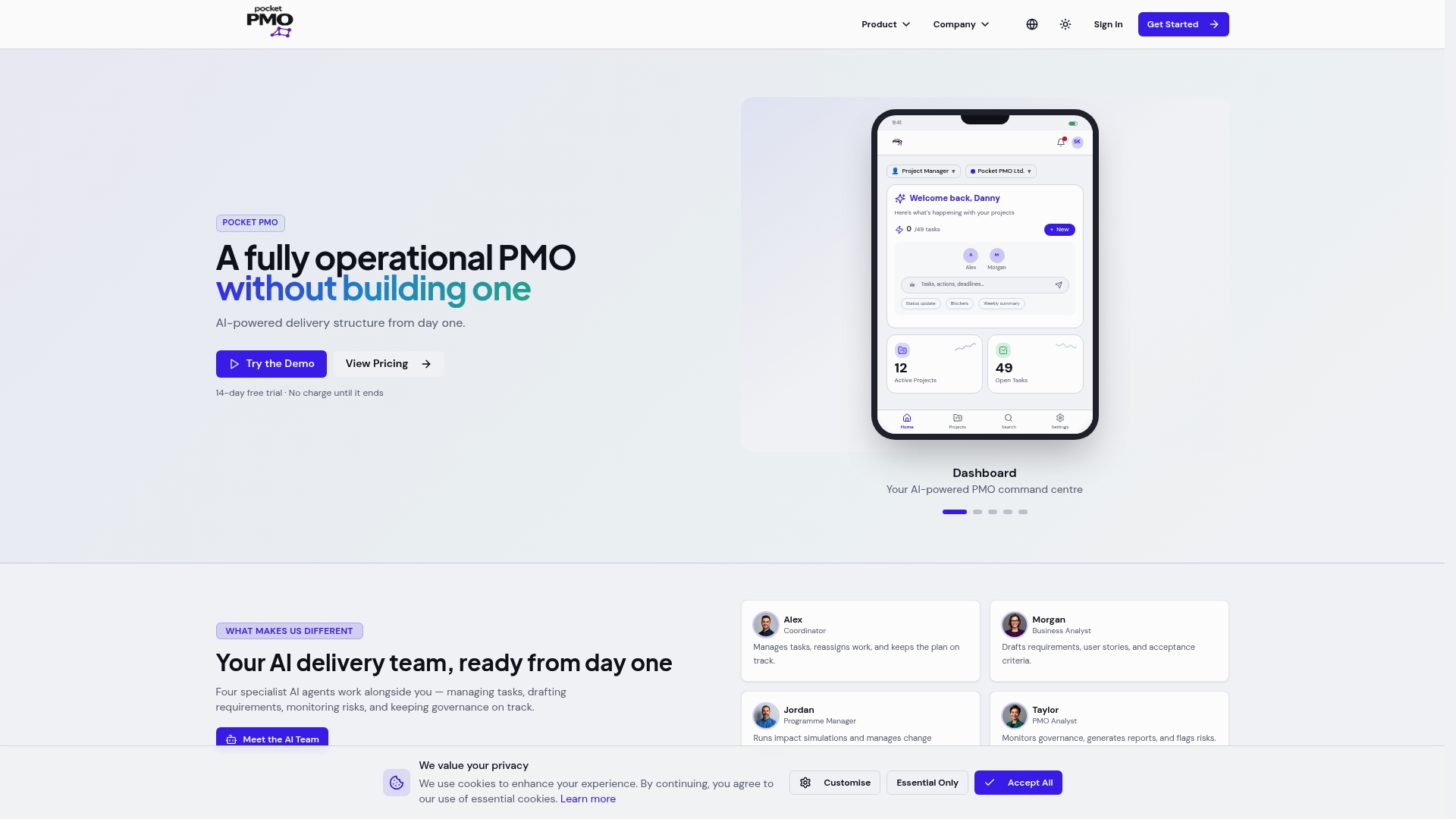
Whether you're launching your PMO from scratch or scaling an existing function, the platform gives you the tools to monitor, escalate, and act with confidence. You can explore features to see how automated reporting, RAG status tracking, and predictive analytics work together to keep your projects on track. Request a demo and see the difference that purpose-built monitoring makes.
Frequently asked questions
What is the main purpose of project health monitoring?
Project health monitoring provides early warning of issues like delays, cost overruns, or risks so that you can respond proactively and keep projects on track, shifting management from reactive to proactive.
What are the top project health indicators to track?
The most important indicators are cost variance, schedule variance, RAG status, earned value, and stakeholder engagement scores. Key KPIs include cost and schedule variance, earned value metrics, and RAG status.
How does project health monitoring improve stakeholder confidence?
By making performance trends visible and sharing timely, accurate information, monitoring builds trust. Transparent communication builds stakeholder trust and enhances buy-in across the project lifecycle.
What is a RAG status in project health monitoring?
RAG (Red, Amber, Green) is a quick visual tool showing project status: green for on track, amber for developing concerns, and red for major risks. RAG status gives teams an immediate, consistent signal without requiring a detailed report.
Can AI really make a difference in project health monitoring?
Yes, AI can forecast risks and trends earlier than manual checks, letting teams act on predictive insights. AI-driven predictive insights enable resource reallocation and support portfolio-level decision-making in ways that manual monitoring simply cannot match.
Recommended
- Project tracking with AI: strategies for better results
- Pocket PMO | A fully operational PMO without building one
- Pocket PMO | A fully operational PMO without building one
- Master the multi-project management process: boost success
- Scoreapp - Cleverbit Software
- Proactive monitoring: boost business efficiency and security - IT Start