

Proactive risk management is the practice of identifying and addressing risks before they materialise, giving organisations the ability to prevent losses, protect reputation, and make better decisions. The importance of risk management has never been clearer: 72% of S&P 500 companies disclosed AI-related risks in their 2026 filings, up from just 12% two years earlier. That shift signals a fundamental change in how leadership teams treat uncertainty. Understanding why manage risks proactively is no longer a governance question. It is a competitive one.
What are the key benefits of managing risks proactively?
Proactive risk management moves organisations away from reactive firefighting by identifying root causes before they trigger losses. The financial, regulatory, and reputational benefits are measurable and compounding.
The core advantages include:
- Financial protection. Catching a risk early costs a fraction of managing a full crisis. Budget overruns, contract penalties, and emergency procurement all shrink when risks are spotted at the planning stage.
- Smarter resource allocation. Dashboards and key risk indicators (KRIs) direct leadership attention to the issues that matter most. Teams stop spreading effort thinly and focus where the exposure is highest.
- Reputational resilience. Unmanaged uncertainty causes reputational damage that often exceeds direct economic losses. Stakeholders, clients, and regulators trust organisations that demonstrate they have risk under control.
- Strategic opportunity. Proactive assessment does not just prevent harm. It surfaces opportunities that reactive teams miss entirely, because they are too busy managing the last crisis to see the next one coming.
- Stronger governance. Embedding risk into leadership decisions builds accountability at every level, not just in the compliance function.
The benefits of proactive risk management compound over time. Each risk identified early reduces the probability of a downstream incident, which in turn reduces the cost and disruption of the next planning cycle.
Pro Tip: Set KRIs for your top five risk categories before the start of each financial year. Review them monthly rather than quarterly. Early signals are only useful if someone is watching for them.
How does proactive risk management differ from reactive approaches?
The distinction between proactive and reactive risk management is not just about timing. It is about where responsibility sits and how decisions get made.

Reactive risk management responds to incidents after they occur. The typical pattern is damage control: convene a crisis team, contain the immediate impact, report to the board, and update the risk register retrospectively. This approach is expensive, disruptive, and does nothing to prevent the next incident.
Proactive risk management identifies weak signals early, often during the design or planning phase, before a risk has any chance to materialise. The focus shifts from response to prevention. Leadership teams assess root causes, model scenarios, and build controls into the work itself rather than bolting them on afterwards.
| Dimension | Reactive approach | Proactive approach |
|---|---|---|
| Timing | After the incident | Before the incident |
| Focus | Damage limitation | Root cause prevention |
| Ownership | Compliance or risk team | Leadership and all functions |
| Cost profile | High and unpredictable | Lower and planned |
| Outcome | Recovery | Prevention and opportunity |
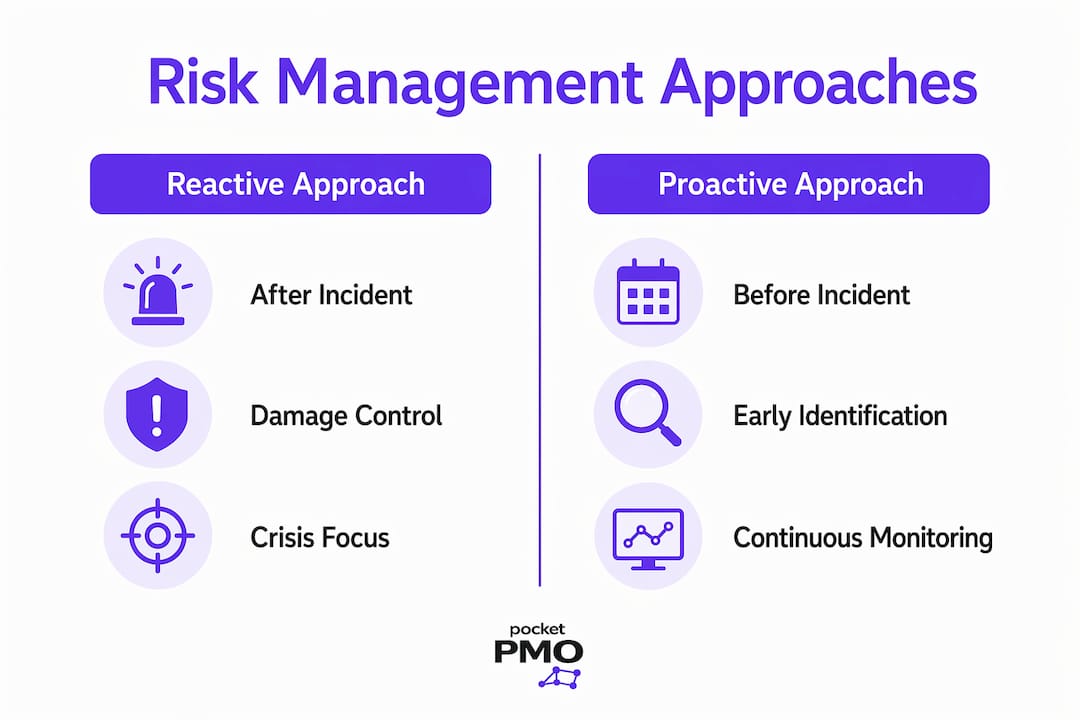
The table above shows a clear pattern: reactive management concentrates cost and ownership in the wrong places. Proactive management distributes both earlier and more efficiently.
Risk management is moving upstream into budgeting, procurement, and operational planning as a direct leadership responsibility. This shift means that risk decisions now happen when they can still influence outcomes, not after the damage is done.
Pro Tip: When reviewing a new project or initiative, ask your team to identify the three most likely failure modes before the first milestone. This single habit shifts the conversation from optimism to realism without killing momentum.
Which frameworks support effective proactive risk management?
Frameworks give structure to proactive risk assessment strategies without turning risk management into a bureaucratic exercise. The two most widely adopted are COSO ERM and ISO 31000.
COSO ERM and ISO 31000 act as flexible guides to align risk practice with governance, strategy, and operations. Neither is a rigid checklist. Both are designed to be adapted to the size, sector, and maturity of the organisation using them.
Alongside these frameworks, several practical tools support day-to-day proactive risk assessment:
- Failure Mode and Effects Analysis (FMEA). FMEA maps every step of a process and asks what could go wrong at each point. It assigns severity, probability, and detectability scores to each failure mode, producing a prioritised list of risks to address.
- Horizon scanning. This technique monitors the external environment for emerging trends, regulatory changes, and technological shifts that could affect the organisation in the medium to long term. It is particularly useful for AI-related risk disclosure, which has grown dramatically in recent years.
- Key risk indicators (KRIs). KRIs are quantitative metrics that signal when a risk is approaching an unacceptable level. They work best when tied directly to operational data, such as supplier lead times, staff turnover rates, or system uptime.
- Scenario planning. Leadership teams model best-case, base-case, and worst-case scenarios for major decisions. This forces explicit discussion of assumptions and exposes hidden dependencies.
For a practical starting point, a structured risk register template gives your team a consistent format to capture, score, and track risks across projects and portfolios.
Proactive risk management is not a checklist but a decision-making framework that embeds risk awareness into leadership and operations. The frameworks above work best when they are integrated into existing governance cycles, such as quarterly business reviews, project stage gates, and budget approvals, rather than run as separate risk exercises.
Integrating risk into budgeting and procurement decisions is where the real value appears. When finance teams model risk-adjusted returns and procurement teams assess supplier concentration before signing contracts, the organisation builds resilience into its cost base rather than discovering vulnerabilities under pressure.
For leaders managing multiple projects simultaneously, practical risk management guidance on applying these frameworks at project level can accelerate adoption without requiring a full PMO rebuild.
How can organisations embed a proactive risk culture?
Culture is where proactive risk management either takes hold or quietly dies. A framework on paper means nothing if the people running projects do not use it.
Embedding risk awareness into culture and governance, rather than relying on isolated checklists, is the defining factor in successful proactive risk management. Organisations that treat risk as a shared responsibility across all functions outperform those that confine it to a specialist team.
Practical steps to build that culture include:
- Assign clear ownership. Every risk on the register needs a named owner with the authority and budget to act. Unowned risks do not get managed.
- Make risk visible. Real-time dashboards that surface KRIs and risk status give leadership teams the information they need without waiting for a monthly report. Continuous monitoring using KRIs and incident reports refines controls and detects emerging risks early.
- Train at every level. Risk awareness training should not stop at the senior leadership team. Project managers, team leads, and delivery staff all encounter risks first. Giving them the language and tools to escalate early is one of the highest-return investments a leader can make.
- Reward early escalation. Organisations that punish people for raising risks get fewer risks raised. The ones that reward early escalation get better information and fewer surprises.
Pro Tip: Add a standing "risk and assumptions" agenda item to every project status meeting. It takes five minutes and creates a habit of surfacing issues before they become incidents.
The role of technology in sustaining risk culture is significant. Platforms that centralise risk data, automate status reporting, and flag threshold breaches free up leadership time for decision-making rather than data gathering. For leaders considering how AI fits into this picture, the role of AI in consultancy offers relevant context on how AI tools are reshaping risk oversight in professional services.
Sound financial governance sits alongside risk culture. Organisations that integrate outsourced accounting services into their risk oversight model gain an independent view of financial exposure, which strengthens the overall picture leadership teams rely on.
Key takeaways
Proactive risk management reduces cost, protects reputation, and builds the organisational resilience that reactive approaches cannot deliver.
| Point | Details |
|---|---|
| Act before incidents occur | Identifying risks at the planning stage costs far less than managing a crisis after the fact. |
| Use KRIs and dashboards | Key risk indicators direct leadership attention to the highest-exposure areas in real time. |
| Adopt flexible frameworks | COSO ERM and ISO 31000 provide adaptable structures that align risk practice with strategy and governance. |
| Embed risk into culture | Assigning ownership, rewarding escalation, and training at every level sustains proactive behaviour. |
| Move risk upstream | Integrating risk decisions into budgeting and procurement prevents vulnerabilities from being built into the cost base. |
Why I think most leaders underestimate this shift
The organisations I have seen struggle most with risk are not the ones that lack a risk register. They have registers. They have frameworks. They even have dedicated risk managers. What they lack is the habit of treating risk as a leadership input rather than a compliance output.
The upstream shift described by risk practitioners is real and it is accelerating. When 72% of S&P 500 companies are now disclosing AI-related risks in their filings, compared to 12% just two years ago, that is not a compliance trend. That is a signal that boards and executive teams are being held accountable for risks they previously ignored or delegated away.
The leaders who get this right share one characteristic: they ask about risk at the beginning of every major decision, not at the end. They do not wait for the risk team to produce a report. They treat uncertainty as a design input, not a post-launch problem.
The uncomfortable truth is that reactive risk management feels efficient until it is not. It saves time in the short term by skipping the hard conversations. Then one incident wipes out months of progress and everyone wonders why no one saw it coming. Someone usually did. They just did not have the forum, the framework, or the permission to say so.
Build the forum. Use the framework. Give people permission to raise bad news early. That is the whole practice, distilled.
— Danny
How Pocketpmo supports proactive risk management
Pocketpmo gives leadership teams the tools to practise proactive risk management without building a PMO from scratch.
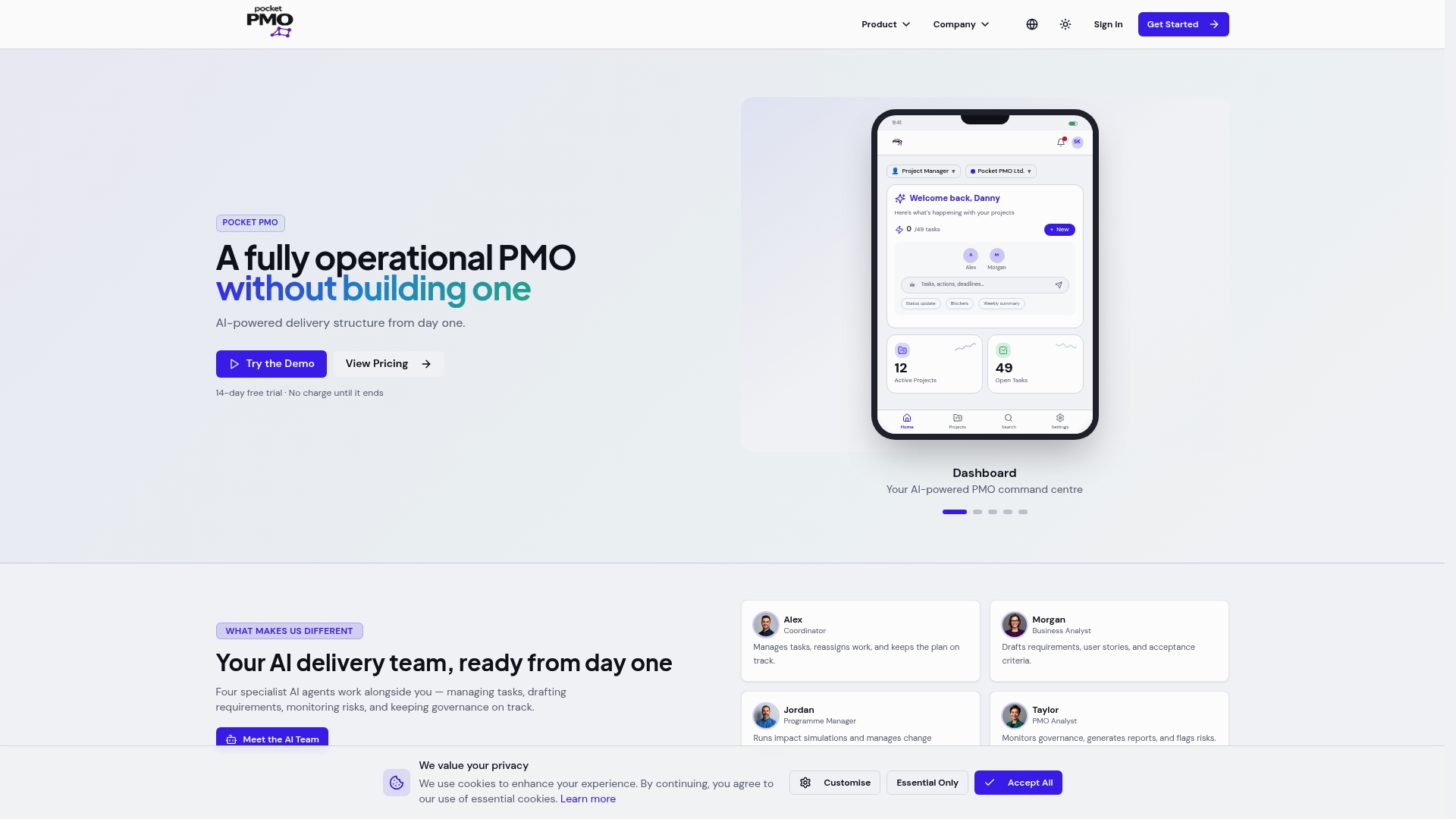
The platform combines real-time risk dashboards, AI-driven risk analysis, and automated status reporting in a single environment. You can track KRIs across your entire portfolio, assign risk ownership, and receive early warnings before issues escalate. The risk register template gives your team a structured starting point for capturing and scoring risks consistently. For leaders who want to understand the full platform capability, the Pocketpmo features page covers portfolio management, change request workflows, and continuous monitoring in detail. Start managing risks before they manage you.
FAQ
What does proactive risk management mean?
Proactive risk management is the practice of identifying and addressing risks before they materialise. It focuses on root cause prevention rather than incident response.
Why is risk management essential for business leaders?
Risk management is essential because unmanaged uncertainty causes reputational damage that often exceeds direct financial losses. Leaders who embed risk into planning decisions protect both value and stakeholder trust.
What frameworks support proactive risk assessment strategies?
COSO ERM and ISO 31000 are the most widely adopted frameworks. Both are designed to be adapted to organisational context rather than followed as rigid protocols.
How do KRIs help organisations manage risks proactively?
Key risk indicators are quantitative metrics that signal when a risk is approaching an unacceptable threshold. Monitoring them continuously allows leadership teams to act before a risk becomes an incident.
How does proactive risk management improve project outcomes?
Identifying weak signals early in the design phase reduces the frequency and severity of operational incidents. Projects that integrate risk assessment into planning stages experience fewer costly surprises and more predictable delivery.