

Stakeholder management in projects is defined as the structured, ongoing process of identifying, analysing, engaging, and monitoring every individual or group who influences or is affected by a project. The PMBOK Guide treats it as a core knowledge area, not an optional add-on. Get it right and you accelerate decisions, reduce conflict, and protect your budget. Get it wrong and up to 70% of cross-functional initiatives fail, often because teams treated stakeholder management as a checklist rather than a strategic discipline. This guide covers the core phases, the distinction between management and engagement, and the practical techniques that separate high-performing project managers from the rest.
What is stakeholder management in projects?
Stakeholder management in projects is the systematic practice of identifying who holds influence over your project, understanding their interests and concerns, and then building the relationships needed to keep the work on track. The Project Management Institute defines it within the PMBOK Guide as one of ten knowledge areas, placing it alongside scope, schedule, and risk. That positioning is deliberate. Stakeholder relationships are not peripheral to delivery; they are delivery.
Three concepts sit at the heart of the discipline. First, identification: knowing who your stakeholders actually are, including those who do not appear on an org chart. Second, analysis: understanding each stakeholder's level of power, interest, and potential impact on the project. Third, engagement: actively managing those relationships throughout the project lifecycle, not just at kick-off.

The stakeholder analysis process uses structured frameworks such as the power-interest grid and the RACI matrix to clarify roles and prioritise effort. The power-interest grid plots stakeholders on two axes, showing you who to manage closely, who to keep informed, and who to monitor. The RACI matrix assigns Responsible, Accountable, Consulted, and Informed labels to each stakeholder for every key deliverable. Together, these tools turn a vague list of names into a clear engagement plan.
What are the core phases of stakeholder management?
Stakeholder management follows four core phases: identify stakeholders, plan engagement, manage engagement, and monitor engagement. Each phase builds on the last, and skipping any one of them creates gaps that compound over time.
Phase 1: identify stakeholders
Start by building your stakeholder register. This is a living document that captures each stakeholder's name, role, organisation, level of influence, and primary interests. Go beyond the obvious sponsors and end users. Community leaders, regulatory bodies, internal champions, and even vocal sceptics belong in the register. Initial stakeholder planning typically takes 1–2 weeks at project start, with monitoring continuing throughout the lifecycle.
Phase 2: plan engagement
Use the power-interest grid to segment your stakeholders into four groups: manage closely, keep satisfied, keep informed, and monitor. Then design a tailored communication approach for each group. A C-suite sponsor needs concise executive summaries. A technical lead needs detailed specification reviews. A community group needs plain-language updates and genuine opportunities to raise concerns. One communication template does not serve all four groups.
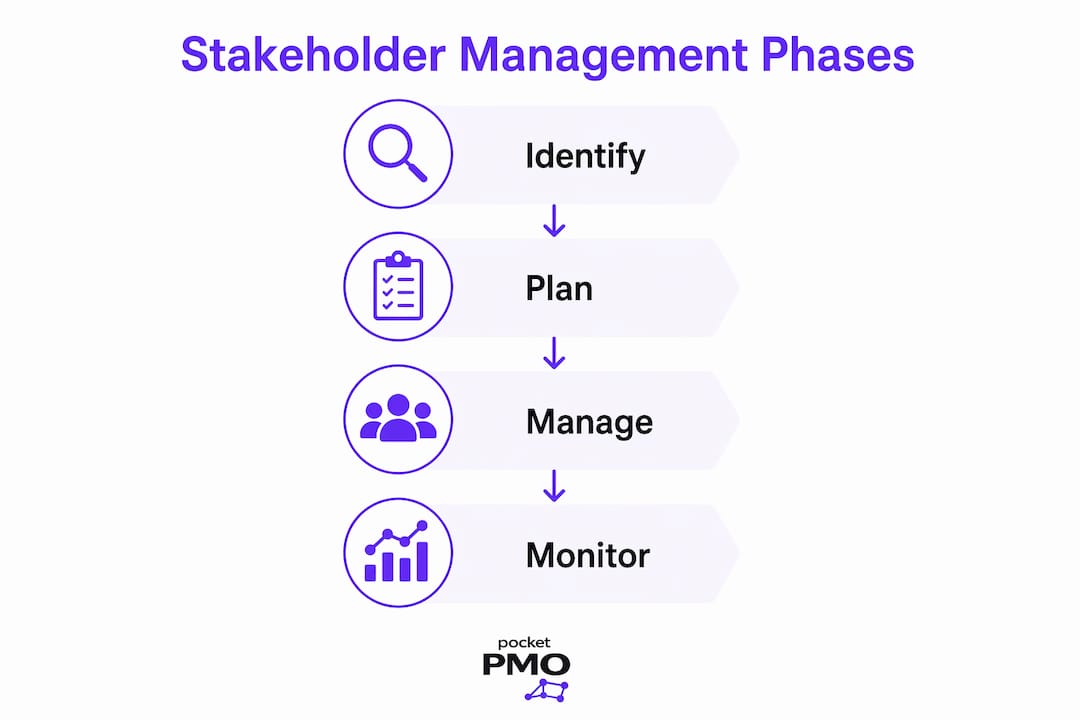
Phase 3: manage engagement
This is where the relationship work happens. Schedule structured touchpoints, resolve conflicts before they escalate, and document decisions and commitments. When competing priorities surface between functional groups, your role is to facilitate informed trade-offs, not to pick sides. Sales teams want immediate features, engineering teams manage technical debt, and the project manager mediates the gap. That mediation is a core skill, not a distraction.
Phase 4: monitor engagement
Track whether your engagement approach is working. Are stakeholders responding to communications? Are decisions being made at the right speed? Are previously resistant stakeholders moving towards support? Adjust your approach based on what the data tells you, not on assumption.
| Phase | Key Activity | Output |
|---|---|---|
| Identify | Map all stakeholders, formal and informal | Stakeholder register |
| Plan | Segment by power and interest; design communication approach | Engagement plan |
| Manage | Build relationships, resolve conflicts, facilitate trade-offs | Documented decisions |
| Monitor | Track engagement quality and adjust approach | Updated register and plan |
Why does stakeholder management matter for project success?
Poor stakeholder management is the single most common cause of project failure that project managers underestimate. Projects lacking proper stakeholder inclusion are twice as likely to exceed budgets. That statistic translates directly to wasted resource, missed deadlines, and damaged organisational credibility.
"Organisations that fail to build trust and alignment with stakeholders are more likely to face project risks, legal issues, and reputational damage." drhamm.net
The damage is rarely technical. Infrastructure projects stall not because engineers cannot build, but because local communities were not consulted early enough. Cross-functional technology programmes collapse not because the code is wrong, but because the business units were not aligned on requirements. The pattern repeats across sectors and project types.
Trust is the underlying currency. Consistent, candid, two-way exchanges that foreground stakeholder concerns build that trust far more effectively than polished status reports. When stakeholders believe their input shapes outcomes, they become advocates rather than obstacles. When they feel managed rather than heard, resistance grows quietly until it surfaces as a formal escalation or a project halt.
The importance of stakeholder management also extends to crisis resilience. Organisations with open stakeholder dialogue adapted better during COVID-19 disruptions than those relying on top-down communication. The lesson is clear: relationships built before a crisis become the mechanism for navigating it.
How do stakeholder management and engagement differ?
Stakeholder management and stakeholder engagement are related but distinct. Confusing them leads to plans that look thorough on paper but fail in practice.
Stakeholder management is the structural layer. It covers identification, analysis, planning, and monitoring. It answers the question: who are our stakeholders, what do they need, and how do we organise our approach to them?
Stakeholder engagement is the relational layer. It covers the quality of interactions, the depth of dialogue, and the degree to which stakeholders feel genuinely involved. It answers the question: are we actually building the trust and collaboration this project needs?
The two must work together. Management without engagement produces bureaucratic processes that stakeholders ignore. Engagement without management produces warm relationships with no structural accountability. The combination is what drives results.
- Management gives you the register, the power-interest grid, and the RACI matrix.
- Engagement gives you the conversations, the feedback loops, and the co-created solutions.
- Neither replaces the other.
- Projects that integrate both report stronger alignment and faster decision-making.
Stakeholder engagement is shifting from a soft skill to a strategic performance lever with measurable project impact. That shift means engagement practices now reduce uncertainty and improve coordination across organisational boundaries in ways that show up in project metrics, not just relationship quality scores.
Pro Tip: Run a brief engagement health check at each project milestone. Ask three questions: Are stakeholders responding promptly? Are decisions being made without repeated escalation? Are previously resistant stakeholders moving towards neutral or supportive? If the answer to any is no, adjust your approach before the next phase begins.
What practical strategies improve stakeholder management?
The gap between average and high-performing project managers often comes down to a handful of specific techniques that most project management training glosses over.
Map the informal network
High-performing project managers map informal influencers who hold significant sway beyond their official titles. A senior developer with no management title who commands the respect of the engineering team is a stakeholder. A long-serving executive assistant who controls diary access is a stakeholder. Failing to map these hidden stakeholders causes resistance and approval delays that formal stakeholder registers miss entirely.
Switch to event-triggered communication
Calendar-driven updates, the weekly status email, the fortnightly steering committee, create meeting fatigue without improving outcomes. Event-triggered communication sends updates based on actions, decisions, or reviews rather than rigid schedules. A stakeholder receives a communication when a risk materialises, a decision is needed, or a milestone is reached. That approach improves actionability and reduces the noise that causes stakeholders to disengage.
Close the feedback loop
Treating stakeholder management solely as communication misses its nature as relationship management. Closing the feedback loop, showing stakeholders what changed as a result of their input, is the single most credibility-building action a project manager can take. When stakeholders see their concerns reflected in decisions, they invest more deeply in the project's success.
| Approach | Outcome |
|---|---|
| Calendar-driven updates | Meeting fatigue, low engagement, missed actions |
| Event-triggered communication | Higher relevance, faster decisions, reduced noise |
| One-way status reporting | Passive stakeholders, undetected resistance |
| Two-way feedback loops | Active advocates, early conflict resolution |
Navigate competing priorities with structure
When sales, engineering, and operations all want different things from your project, the answer is not to avoid the conflict. Effective stakeholder management navigates competing priorities by helping the organisation make supported trade-off decisions. Bring the competing parties into the same conversation, present the data on each option's impact, and facilitate a decision that everyone can live with even if no one gets everything they want.
Pro Tip: Use a free stakeholder register template to capture not just names and roles, but each stakeholder's primary concern, preferred communication style, and current level of support. That depth of data transforms your register from an admin document into a genuine engagement tool.
Key takeaways
Effective stakeholder management requires structured processes, genuine two-way engagement, and the discipline to map informal influencers alongside formal ones throughout the entire project lifecycle.
| Point | Details |
|---|---|
| Four-phase structure | Follow identify, plan, manage, and monitor phases to build a repeatable stakeholder process. |
| Informal influencers matter | Map stakeholders beyond org charts to prevent hidden resistance and approval delays. |
| Engagement builds trust | Two-way dialogue and closed feedback loops convert resistant stakeholders into advocates. |
| Event-triggered communication | Send updates based on actions and decisions, not fixed schedules, to maintain stakeholder attention. |
| Management and engagement are both required | Structural processes without relational quality produce plans that stakeholders ignore. |
Why stakeholder management is a leadership skill, not an admin task
From where I sit, the most common mistake I see project managers make is treating their stakeholder register as a deliverable rather than a tool. They build it at project initiation, file it away, and return to it only when something goes wrong. By that point, the damage is already done.
The project managers who consistently deliver on time and within budget share one habit: they treat every stakeholder interaction as intelligence gathering. Every conversation tells you something about shifting priorities, emerging concerns, or political dynamics that will affect your project before they appear in a formal risk log. That intelligence is only available if you are genuinely listening, not just reporting.
Emotional intelligence matters here more than most project management frameworks acknowledge. Knowing when a stakeholder is disengaged because they are busy versus disengaged because they have lost confidence in the project requires reading signals that no dashboard captures. The ability to have a direct, honest conversation with a resistant sponsor without triggering defensiveness is a skill that accelerates projects more reliably than any process improvement.
The organisations that adapted fastest during the disruptions of recent years were not the ones with the most detailed stakeholder plans. They were the ones with the strongest relationships. Plans are a starting point. Relationships are what you actually manage.
— Danny
How Pocketpmo supports your stakeholder management
Managing stakeholders across multiple projects without a structured system means critical relationships slip through the gaps. Pocketpmo gives you a built-in stakeholder register, engagement tracking, and communication management tools inside a single AI-powered platform, so nothing gets missed.
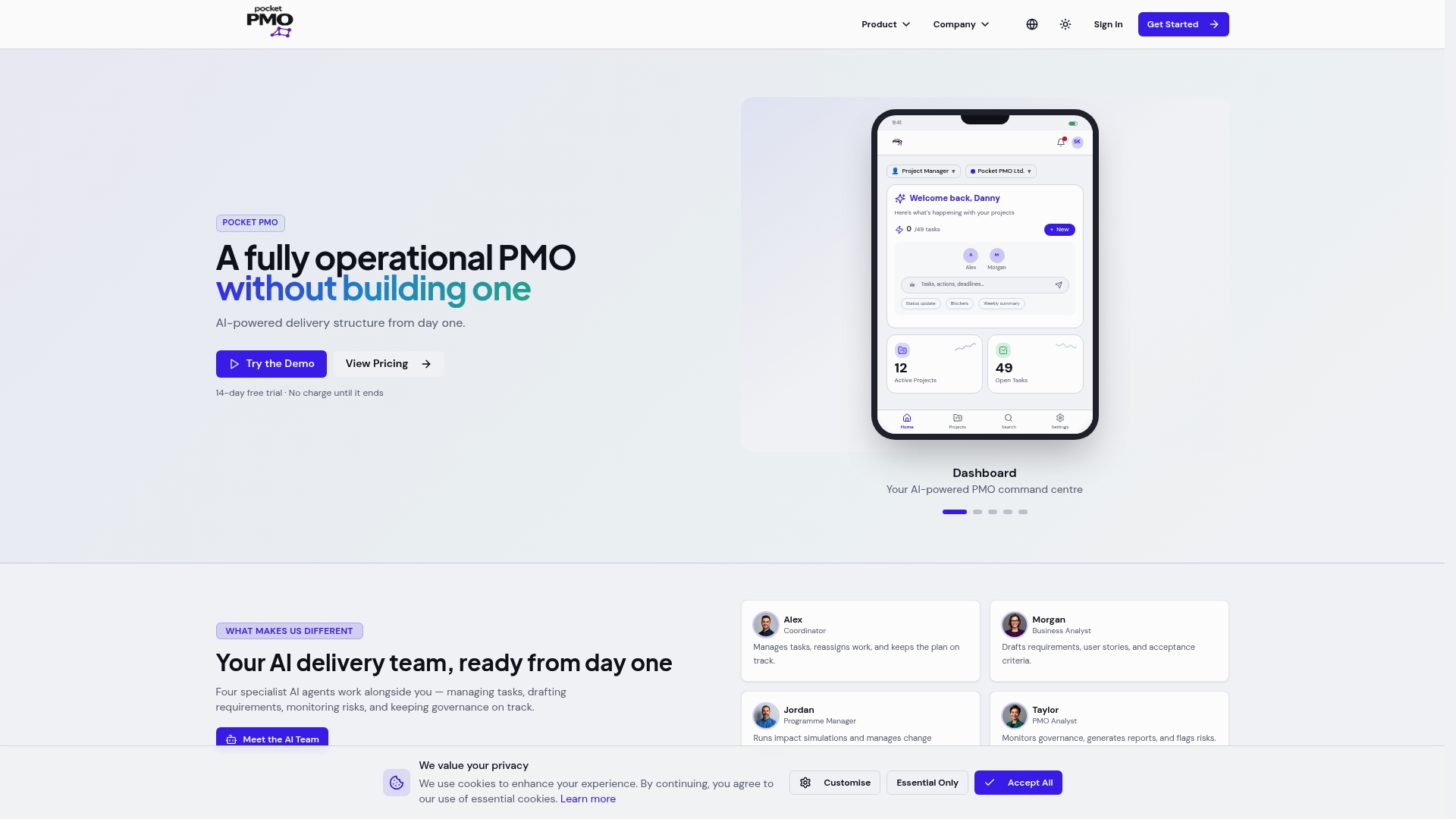
Whether you are comparing your current tools or starting fresh, see how Pocketpmo stacks up against the alternatives. The Pocketpmo vs Monday.com comparison shows exactly where AI-driven stakeholder tracking and portfolio visibility make the difference for busy project managers. You can also explore the full Pocketpmo feature set to see how stakeholder management fits into a complete project delivery workflow. For teams ready to move fast, the AI team demo shows the platform in action from day one.
FAQ
What is stakeholder management in projects?
Stakeholder management in projects is the structured process of identifying, analysing, engaging, and monitoring all individuals or groups who influence or are affected by a project. The PMBOK Guide defines it as a core knowledge area alongside scope, schedule, and risk.
How long does stakeholder planning take at the start of a project?
Initial stakeholder planning typically takes 1–2 weeks at project start, with ongoing monitoring continuing throughout the full project lifecycle.
What is the difference between stakeholder management and stakeholder engagement?
Stakeholder management is the structural layer covering identification, analysis, and planning. Stakeholder engagement is the relational layer covering the quality of dialogue and the depth of collaboration. Both are required for project success.
Why do projects fail due to poor stakeholder management?
Up to 70% of cross-functional initiatives fail when stakeholder management is treated as a checklist rather than a strategic discipline. Projects lacking proper stakeholder inclusion are also twice as likely to exceed budgets.
What tools support effective stakeholder management?
The power-interest grid and RACI matrix are the two most widely used frameworks. These structured tools clarify stakeholder roles and improve decision-making clarity across the project team.