

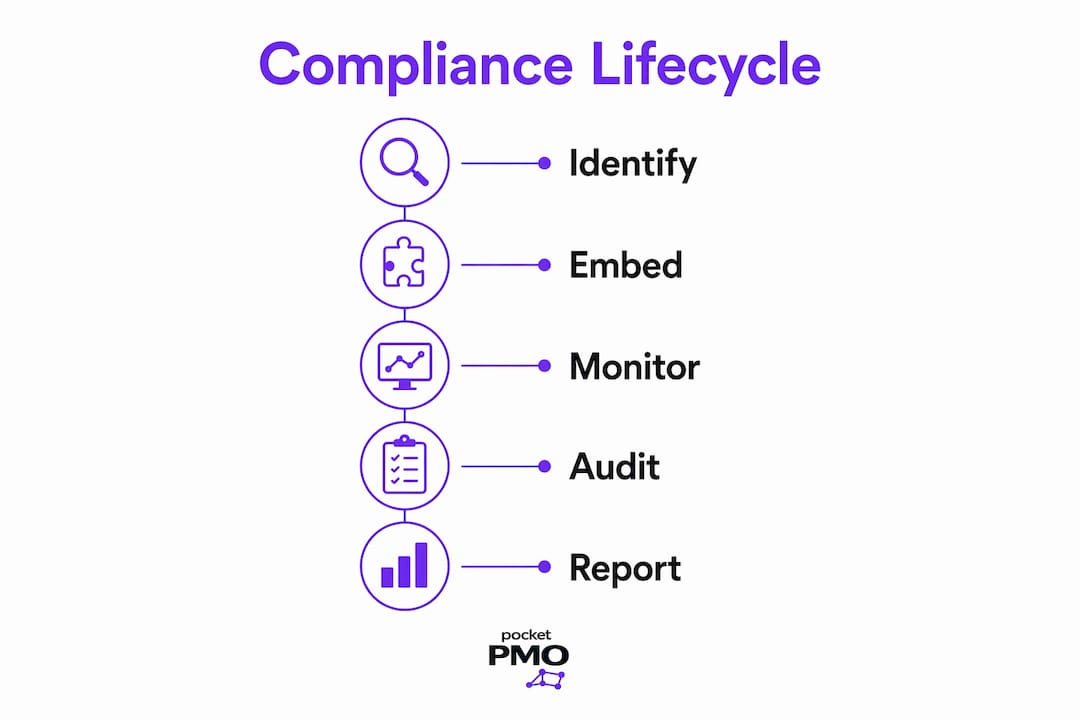
Compliance management in projects is defined as the active process of translating legal, regulatory, and internal standards into controls and workflows embedded throughout every stage of project delivery. Known formally as project compliance management, this discipline sits at the heart of sound governance and risk control. Compliance is no longer a static end-of-project task; it must be embedded early to prevent costly rework and protect the project from legal or financial exposure. PMI's PMP 2026 guidelines treat compliance as a continuous, integrated process, not a final checkpoint. For project stakeholders and team members, understanding what is compliance management in projects is the first step to keeping delivery on track and audit-ready.
What is compliance management in projects: key components and frameworks?
Compliance management in projects rests on four distinct categories of obligation. Getting these categories clear before planning begins prevents gaps that surface at the worst possible moment.
The four compliance categories:
- Legal requirements. Statutory obligations imposed by national or regional law, such as data protection legislation or health and safety regulations.
- Regulatory requirements. Rules set by sector bodies, such as financial conduct authorities or environmental agencies.
- Internal policies. Organisational standards covering procurement, information security, or financial controls.
- Industry standards. Frameworks such as ISO 9001 for quality or ISO 27001 for information security that projects must demonstrate adherence to.
Each category demands its own controls, documentation, and ownership. A project compliance framework ties these together through four structural components: defined controls, documented evidence, named owners, and continuous monitoring. Risk assessment sits inside this framework, not alongside it. Before a project baseline is set, the team should map every compliance obligation to a risk, assign a likelihood and impact score, and record the mitigating control in the risk register.
Pro Tip: Use a RACI matrix specifically for compliance activities. Assign one person to interpret each requirement, a separate person to execute the control, and a named approver. This prevents the most common failure mode: assuming someone else has it covered.
Project governance frameworks, such as PRINCE2 or the PMI governance model, provide the structural backbone that compliance controls attach to. Governance defines the decision gates; compliance defines what evidence must exist before each gate can be passed. The two work together, not in parallel.
| Framework element | Compliance function |
|---|---|
| Project charter | Records applicable legal and regulatory obligations |
| Work breakdown structure | Maps compliance tasks to deliverables |
| Risk register | Logs compliance risks and mitigating controls |
| Status reports | Tracks control execution and outstanding gaps |
| Lessons learned log | Captures compliance failures for future projects |
How to ensure compliance throughout the project lifecycle?
Embedding compliance into the project lifecycle requires deliberate action at each phase. The following steps reflect best practice from PMI's PMP 2026 framework and align with how experienced project teams manage regulatory oversight.
-
Identify obligations at initiation. Before the project scope is finalised, list every legal, regulatory, internal, and industry standard that applies. Engage your legal, finance, and information security teams at this stage, not later.
-
Map requirements to deliverables. Mapping compliance requirements to deliverables and acceptance criteria before work begins enables natural, ongoing evidence generation. This approach prevents compliance gaps and eliminates retrospective paperwork.
-
Assign explicit ownership. The project manager need not be a legal expert, but must assign clear ownership for interpreting and performing each compliance control. Assuming requirements are covered without explicit responsibility causes critical non-compliance.
-
Embed compliance tasks in the work breakdown structure. Treat compliance activities as deliverables with owners, deadlines, and acceptance criteria. If a task does not appear in the plan, it will not get done.
-
Monitor continuously with dashboards and status reports. Real-time dashboards give project managers visibility of control execution across the full portfolio. Weekly status reports should include a compliance section that flags outstanding actions and escalation items.
-
Handle gaps with corrective actions. When a compliance gap surfaces, log it formally, assign a corrective action owner, set a resolution date, and communicate the status to relevant stakeholders. Silence on a compliance gap is never acceptable.
Pro Tip: Build a project compliance checklist into your project initiation document template. A checklist forces the team to confirm each obligation is assigned and documented before the project moves into execution.
Effective management of project requirements is inseparable from compliance. When requirements are well-defined and traceable, compliance evidence collects itself as a natural by-product of delivery.

What are common challenges and risks of poor compliance management in projects?
Poor compliance management produces consequences that extend well beyond a failed audit. The risks fall into three categories: legal and financial, operational, and reputational.
Common causes of compliance failure:
- Unclear ownership, where team members assume someone else is responsible for a control.
- Late identification of obligations, discovered only during a pre-launch review.
- Inadequate documentation, where evidence of control execution is missing or inconsistent.
- Scope changes that introduce new regulatory obligations without a corresponding compliance review.
- Insufficient training, where team members do not recognise a compliance obligation when they encounter one.
Failure to integrate compliance leads to legal and financial penalties and risks project suspension or licence revocation. That outcome is not theoretical. Projects in regulated sectors such as financial services, healthcare, and construction face enforcement action when controls are absent or poorly evidenced.
"Treating compliance as a check-the-box activity results in poor evidence collection and audit failures. Compliance must be seen as a continuous discipline driving corporate excellence, not a legal formality completed at the end of a project."
Operational disruption is the less-discussed consequence. A project suspended mid-delivery to address a compliance failure loses momentum, incurs rework costs, and damages team morale. Stakeholder trust erodes quickly when a governance failure becomes visible. Clear roles for compliance activities improve clarity and reduce execution risk, and open communication about compliance expectations directly enhances stakeholder confidence.
The reputational dimension matters for consultancies and PMOs in particular. A single high-profile compliance failure can affect client relationships across an entire portfolio. For owner-reliant businesses, the risk is amplified when compliance knowledge sits with one individual rather than being embedded in team processes.
How does compliance management interrelate with governance and risk management?
Compliance and risk management are interdependent. Effective governance depends on integrating both. Compliance ensures adherence to standards; risk management anticipates and mitigates threats. Together, they form the foundation of transparent, accountable project delivery.
The practical integration works as follows. Compliance obligations feed directly into the risk register as identified risks. Each risk carries a mitigating control, which is a compliance activity. The governance framework then defines who reviews those controls, at what frequency, and what decision authority exists when a control fails. This creates a closed loop: compliance informs risk, risk informs governance, and governance enforces compliance.
| Management discipline | Primary focus | Integration point |
|---|---|---|
| Compliance management | Adherence to standards and regulations | Feeds obligations into risk register and governance gates |
| Risk management | Anticipating and mitigating threats | Uses compliance controls as risk mitigations |
| Project governance | Decision-making authority and accountability | Enforces compliance and risk review at defined gates |
Audit readiness is the clearest benefit of this integration. When compliance controls are logged in the risk register and reviewed at governance gates, the audit trail builds automatically. Project teams do not need to reconstruct evidence after the fact. For project management oversight, this integrated approach reduces the time spent preparing for external reviews and increases confidence in the evidence presented.
What practical steps can project teams adopt for effective compliance management?
Effective compliance management strategies require deliberate process design, not good intentions. The following best practices for compliance management reflect what experienced project teams do consistently.
-
Map obligations before work begins. List every applicable requirement and link it to a specific deliverable or acceptance criterion. This is the single most effective action a project team can take to prevent compliance gaps.
-
Standardise documentation. Proper documentation through templates and audit trails is fundamental for compliance in heavily regulated projects. Use standard templates for evidence collection so that every team member captures information in the same format.
-
Define roles explicitly. Assign one person to interpret each requirement, one to execute the control, and one to approve the evidence. Document these assignments in the project responsibility matrix.
-
Monitor with real-time dashboards. A compliance status dashboard gives project managers and stakeholders a live view of which controls are complete, which are in progress, and which are overdue. Weekly status reports should include a compliance section as a standing agenda item.
-
Build a compliance culture. Compliance is better sustained when embedded early and viewed as a continuous, value-driving discipline. Run short compliance briefings at project kick-off and at each phase transition. Make it normal to raise a compliance concern, not exceptional.
Pro Tip: Align your compliance review cycle with your project's change control process. Every approved change request should trigger a compliance impact assessment before implementation begins.
Risk management guidance for 2026 consistently points to early integration as the differentiator between projects that pass audits and those that scramble to produce evidence. The teams that treat compliance as a delivery discipline, rather than a legal obligation, finish projects faster and with fewer surprises. For scaling organisations, embedding compliance into standard project templates is the most efficient path to consistent governance across a growing portfolio.
Key takeaways
Compliance management in projects is a continuous, embedded discipline that protects delivery, governance, and stakeholder trust at every stage.
| Point | Details |
|---|---|
| Define obligations early | Map every legal, regulatory, and internal requirement before the project scope is finalised. |
| Assign explicit ownership | Name one person to interpret, one to execute, and one to approve each compliance control. |
| Embed into the work breakdown structure | Treat compliance tasks as deliverables with deadlines and acceptance criteria, not background activities. |
| Integrate with risk and governance | Log compliance obligations in the risk register and review them at every governance gate. |
| Monitor continuously | Use real-time dashboards and weekly status reports to track control execution and flag gaps early. |
Compliance is not a hurdle. It is how good projects stay good.
I have reviewed projects where the team was genuinely committed to quality, yet still failed an audit. The reason was almost always the same: compliance was treated as something that would sort itself out by the time the project closed. It never does.
The most persistent misconception I encounter is that compliance belongs to the legal or risk team. Project managers often see it as someone else's domain. The reality is that compliance lives in the daily decisions made by delivery teams: which version of a document gets approved, whether a change request triggers a regulatory review, whether evidence of a control is captured at the time or reconstructed later. Those decisions happen at team level, not in a legal department.
What I have found works is treating compliance the same way you treat a critical path task. It has an owner, a deadline, and a definition of done. When it slips, you escalate. When it is complete, you document it. That discipline, applied consistently, is what separates projects that sail through audits from those that spend weeks in remediation.
The teams that get this right also tend to have better governance overall. Compliance forces clarity: who decides, who does, who checks. That clarity benefits every part of the project, not just the regulatory elements. Viewing compliance as a structural asset, rather than a regulatory burden, is the shift that changes how a team operates.
— Danny
How Pocketpmo supports compliance management in your projects
Pocketpmo gives project teams the tools to manage compliance, governance, and risk in one place, without building a PMO from scratch.
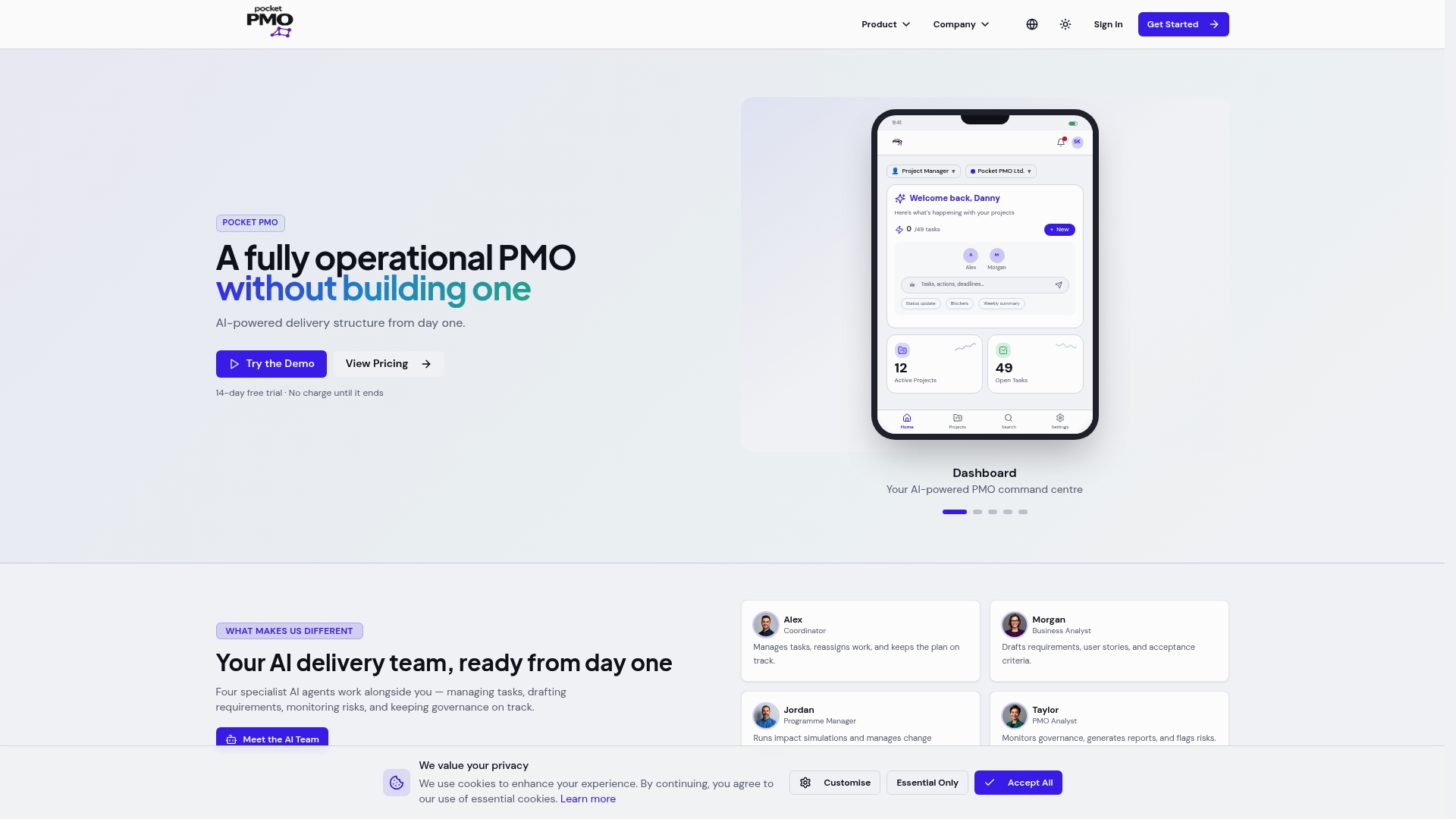
The platform's AI-powered delivery features include real-time dashboards for tracking control execution, change request workflows that trigger compliance impact assessments automatically, and AI-driven risk analysis that maps obligations to your risk register. Evidence collection is built into the delivery workflow, so audit readiness is a by-product of normal project activity, not a last-minute effort. Teams using Pocketpmo reduce manual compliance tracking and gain the visibility needed to make confident decisions at every governance gate. See why Pocketpmo is built for project managers who take governance seriously.
FAQ
What is compliance management in projects?
Compliance management in projects is the active process of identifying, embedding, and monitoring legal, regulatory, and internal requirements as controls throughout the project lifecycle. It ensures projects meet all obligations at every stage, not just at closure.
How do you ensure project compliance during delivery?
Map compliance requirements to specific deliverables and acceptance criteria before work begins, assign named owners for each control, and monitor execution through real-time dashboards and weekly status reports.
What happens if a project fails to manage compliance?
Non-compliance can result in legal penalties, financial fines, project suspension, or licence revocation. It also damages stakeholder trust and can disrupt delivery across an entire portfolio.
What is the difference between compliance management and risk management?
Compliance management ensures adherence to defined standards and regulations. Risk management anticipates and mitigates threats. The two are interdependent: compliance obligations feed into the risk register as identified risks, and risk controls are often compliance activities.
What should a project compliance checklist include?
A project compliance checklist should cover identification of applicable legal and regulatory requirements, mapping of obligations to deliverables, assignment of ownership for each control, documentation standards, and a monitoring schedule aligned to governance review gates.